Author: Andrew

  • Purpose – The Re-Release

    Purpose – The Re-Release

    Purpose available for sale or for free on Kindle Unlimited.

    Get your copy of Purpose here:

    With the return of my rights, Purpose is the first of my books to be re-released. I’ve decided that until I get a better hold on self-publishing, I’m going to be re-release all my titles only on Amazon. Once I get the infrastructure in place on my site to be able to sell directly, I’ll make it available in other formats.

    Purpose is a difficult story to shelve. It’s urban fantasy, but it’s not shifters nor super heroes, not mutants, magic nor people with mental abilities. But it has a bit of all those (well maybe not magic).

    Cover art by AngstyG.

    William Morgan is host to the Spirit of Vengeance. He hears the innocent dead calling out for retribution. In order to quiet the spirit, he is forced to exact vengeance on the killers.

    In exchange for his ‘help,’ Will gains increased strength and speed, he barely ages, is impervious to most injuries and his mental abilities are well beyond a normal person. For some it might be a fair exchange, but not for Will. He wasn’t prepared for what was required.

    To keep from going mad, Will hid behind Gar, an alter ego he created for himself. He suppressed his emotions and walled himself off from not only interpersonal relationships, but his humanity as well. His coping mechanism served him well until he met someone who forced him to examine what he’d become and who challenged him to care again.

    When something threatens the person he cares about, Will is reminded why he chose to hide behind Gar. Purpose is the story of Will’s struggle to rediscover his humanity, and once found, his fight to keep from losing it again. Forever.

    If you’re looking for something a bit different, this is your book. Give it a try and let me know what you think.

    The book trailer below, but it was made for the original release, but I really liked how it turned out so I’m keeping it. Just ignore the ‘available from DSP Publications’ at the end.

    Get your copy of Purpose here:

  • Series Starter eBook Giveaway

    Series Starter eBook Giveaway

    The year – and decade – is rushing to an end, but here’s a way to start the new year and decade off right. Find a new series to engage you in the fantastic.

    All the month, I’m joining with other Sci-Fi/Fantasy authors to give away the first book in a series. There are over 180 different books to choose from so there have to be a few you’ve never tried, but should. Click the link below to be taken to the giveaway page.

    Series Starter eBook Giveaway

    If you find something particularly interesting, let me know. I’m always interested in new good stuff and I might not have read it yet,

    As we leave this year, (and decade) I want to thank everyone for their continued support. I wish you all peace, joy, happiness, and lots of awesome reading.

    ~Enjoy the Journey

  • Autumn Reading

    Autumn Reading

    Summer (at least in the Northern Hemisphere) doesn’t officially end until the autumnal equinox on September 23rd, but most parents mark the end of summer when the kids go back to school. As the days get shorter, that means we spend more time inside. And what better way to spend that extra inside time than discovering new authors who you can fanperson. To help you find new reading material, I joined a fantasy eBook giveaway this month. There are 50+ different books to choose from, which I have to think is more than enough to get you through the fading light of autumn.

    Click here to check out the books available.

    Now, being realistic, I can’t read all of the ones I find interesting, but if you get a chance, please leave a comment with any that you read that you enjoy, or have read and enjoyed in the past.

    ~Enjoy the Journey!

  • New Release Blog Tour — A Fall in Autumn; by Michael G. Williams

    Michael G. Williams has a new queer sci fi book out: A Fall in Autumn.

    Cover for A Fall In Autumn by Michael G. Williams

    WELCOME TO THE LAST OF THE GREAT FLYING CITIES

    It’s 9172, YE (Year of the Empire), and the future has forgotten its past.

    Soaring miles over the Earth, Autumn, the sole surviving flying city, is filled to the brim with the manifold forms of humankind: from Human Plus “floor models” to the oppressed and disfranchised underclasses doing their dirty work and every imaginable variation between.

    Valerius Bakhoum is a washed-up private eye and street hustler scraping by in Autumn. Late on his rent, fetishized and reviled for his imperfect genetics, stuck in the quicksand of his own heritage, Valerius is trying desperately to wrap up his too-short life when a mythical relic of humanity’s fog-shrouded past walks in and hires him to do one last job. What starts out as Valerius just taking a stranger’s money quickly turns into the biggest and most dangerous mystery he’s ever tried to crack – and Valerius is running out of time to solve it.

    Now Autumn’s abandoned history – and the monsters and heroes that adorn it – are emerging from the shadows to threaten the few remaining things Valerius holds dear. Can the burned-out detective navigate the labyrinth of lies and maze of blind faith around him to save the City of Autumn from its greatest myth and deadliest threat?

    A Fall in Autumn Buy Links

    Falstaff Books | Amazon US | Amazon UK | Amazon CAN | Goodreads

    Giveaway

    Michael is giving away an eBook copy of “Perishables,” book one of The Withrow Chronicles, with this post:

    Everybody hates their Homeowner’s Association, and nobody likes a zombie apocalypse. Put the two together, and Withrow Surrett is having a truly craptastic night.

    Enter via Rafflecopter:

    a Rafflecopter giveaway

    Direct Link: http://www.rafflecopter.com/rafl/display/b60e8d4765/?

    Excerpt

    I figured out a long time ago the biggest freak int he whole show gets two things: spat on and space. I could handle one if it got me the other.

The future has forgotten its past.

    This excerpt comes from the second chapter of the book. To set this up, I’ll note that Valerius is a private eye in the far future. In his time, androids are referred to as “golems” and they’re considered to be sort of living saints: they embody the best of a former age, and they tend to wrap themselves in mystery in a way Valerius finds at least a little off-putting.

    Valerius has awakened bruised and battered after getting beaten up by his last client. Alejandro – who is a golem – found him after and helped get him on his feet. Valerius then returned home, passed out, and had to hide from his landlady the next morning because he’s perpetually late on his rent.


    I let out my breath and sat up, pulled on trousers, and stretched to the sound of a hundred popping joints. Whatever kept the landlady at bay was good enough, even if that meant hiding and holding my breath. I cared far less about paying her rent than where I would get food or smokes—oh wait, I’d quit smoking—or a cup of coffee.

    Coffee, I thought. The memory of the stuff was almost enough to wake me. I ran out of Buenos Dias Blend the day before, and I didn’t have a penny to spend on more. I inspected a bottle of Old Indefatigable on top of the filing cabinet. Whiskey in a coffee cup wouldn’t be anything new, and neither would whiskey first thing in the morning, but something about whiskey from a coffee cup first thing in the morning seemed unacceptably perverse.

    I lifted the bottle and put my hand on the stopper, but there was a second knock, one much quieter and more reserved. It sounded an awful lot like a customer’s knock: the sort of knock that said they were sorry for bothering me but sorrier for having a problem in the first place, and still not as sorry as they would be to pay. I put the bottle back on the file stand and nudged the button to unlock the door.

    Alejandro opened it and stepped inside as quietly as a cat in a bassinet, then closed it behind him with a click the baby would have slept through. Normally, the hinges squeaked and the door took jiggling to get closed. I’d always heard a golem’s senses were way beyond ours, but I had no idea. I blinked and set down my coffee mug, still empty of whiskey or coffee or anything, and nodded. “Well.” I tried not to look surprised. I probably failed. “Okay.”

    Whereas it had been dark and dramatic a few days ago, Alejandro’s skin was now an off-white with hints of gray where an egg’s shell might have shades of beige or tan. His hair changed to a deep reddish purple. I had assumed golems were fixed in their appearance, and in that moment, it occurred to me to wonder why I ever assumed that in the first place. No reason they can’t swap things around like any Plus.

    Taking in his choices of colors, my mind kicked around words like “eggplant” and “burgundy” before deciding they fell short. The golem’s hair was pulled back and tied into a neat ponytail. It hung so that it hit the middle of his back exactly between where his shoulder blades would have been if he were a living man. He stood maybe two meters tall, maybe taller, easily several centimeters taller than I am, so I had to look up a little to meet his eyes. It had a sobering effect: he seemed instantly superior in the social hierarchy.

    I reminded myself everything about a golem is literally by design. If he was tall enough to make most people look up to him, it could only be a deliberate choice, almost certainly meant to convey authority—one I found, ironically, a little off-putting.

    Alejandro had good cheekbones, a pair of pale and expressive lips, eyebrows that jutted at a barely noticeable obtuse angle over his eyes, and a prominent Adam’s apple. I thought that was an unusual touch of mimicry for something otherwise obviously constructed. Why bother with the laryngeal prominence if anyone could tell he was made of some kind of cellulose and bioplas? The various design choices taken together suggested ambivalence: maybe a team expressing in their work some internal conflict about how human he should or shouldn’t be, or maybe a Doc Frankenstein somewhere who was never quite at peace with the idea of his or her creation.

    My initial over-analysis of his design and execution bothered me in the way I was always bothered by my detective’s reflex of seeing motives behind every detail. But, I also knew a part of what bothered me about him was what bothered me about the idea of golems in general: no one knows who made them or where they came from. All anybody knows is they’re ancient. Sometimes they’re very kind, and sometimes they’re assholes, and sometimes they’re just sort of there, dissociated and distant in a way some people read as snobbery, and regardless of what they’re like socially, absolutely none of them will admit their origins. They’ve been asked plenty of times, of course, and the urban legend goes that once in a while one of them will open up enough to say she or he doesn’t know whence they came. I never liked that answer. It’s the sort of non-answer politicians give when they want to make you feel like they answered your question. It’s a deflection. I hate people who play that sort of game.

    The fact Alejandro was drop-dead gorgeous—as walking, talking kewpie dolls go—didn’t help me get over my prejudices. If anything, it made me wary. The most dangerous thing in the world is a good marketing campaign, and he looked like a doozy.

    “I hope you don’t mind I’m here.” He murmured it with a small smile that seemed genuinely apologetic rather than the cocky sort of ironic I would have expected from some biological Casanova. “I was concerned about you.”

    I arched an eyebrow. Neither of us moved. I stood between the cabinets and my desk, Alejandro right inside the door, maybe five meters away. A little sunlight slid down the slats in the still-closed blinds in my window, and I still stood barefoot in dingy denim trousers and no shirt. “You figured out who I am.” I pointed a thumb at the handset on my desk. “You could have called.” I picked the cup back up.

    Perverse or no, I was going to fill it with whiskey.


    Partly I love this scene because it’s the moment Alejandro becomes Valerius’ client, which is the engine driving the rest of the book. But partly I love this scene because it’s sort of the last gasp of the old Valerius, before he hears Alejandro’s story, before everything changes for him. It’s the last time we see a version of Valerius that truly believes he’s all washed up and wrung out. He doesn’t think there’s any reason left to try – at anything, really – and that nihilism is eating him alive. I realized as I wrote the book that Valerius hated himself for all sorts of reasons before Alejandro came along, and though this isn’t a romance, it’s certainly a deep and meaningful relationship that develops into a lifeline for Valerius, a way to imagine a future for himself. (And, for various reasons, that’s strongly bittersweet.)

    Valerius can be a jerk to people, and meeting Alejandro doesn’t “fix” him, but it does shift his perspective. It creates an opportunity for Valerius to re-learn a little more empathy, and to step back from the edge of the abyss of his own problems and get some perspective on them. Any detective story is ultimately about someone who feels empathy for others, because that’s their secret to figuring out the mystery. But at this point in his life, Valerius’ empathy has kind of dried up. The only way to learn empathy – or to re-learn it – is often to receive it from others, and that happens for Valerius in this book at exactly the time when he needs it most. This story becomes a way for Valerius to feel like he can still make a difference in the world, still have purpose, no matter what else he has weighing on him or how much time he might or might not have left.

    What are you working on now, and when can we expect it?

    I’ve just signed a deal for 4 more books in the world of A Fall in Autumn and will be writing the sequel over the summer. I can’t wait! I expect the second book, to be titled New Life in Autumn, will be out a year from now.

    Later this year I have several other works, already finished and coming out from Falstaff Books:

    Nobody Gets Out Alive will be coming out sometime soon, probably over the summer. It’s the fifth and final(-ish) book of The Withrow Chronicles, my suburban vampire series about a guy who became a vampire in the 1940’s and has declared himself the boss of all of North Carolina’s blood-drinkers. The series is a ridiculously fun sequence of genre mashups – vampires and zombies, vampires and superheroes, vampires and spy thrillers, vampires and war, vampires and their witch frienemies – telling a story that gets increasingly complex as Withrow slowly but surely learns the world of the supernatural is much bigger than he thought.

    I also have the four-novella San Francisco urban fantasy series, SERVANT/SOVEREIGN. It starts with Through the Doors of Oblivion, and it’s about some of the most evocative moments in San Francisco’s history – such as the 1906 earthquake and fire – and witches and demons and time travel and real estate scams. I’m just exceptionally proud of it, and I get to really focus on the features of San Francisco I most adore, which are not necessarily the parts of the city they try to highlight for tourists. I don’t know exactly when that one is due out, either, but it’s made it through the content edits and the copyeditor and it’s now with the proofreader, so it’s getting close!

    And, last but not least, I’ve reached the rights-reversion point on a bunch of short stories I sold years ago so I’m possibly going to reclaim those rights and produce an anthology of short stories and nonfiction essays I’ve written for various venues. That’s a maybe, though. We’ll see.

    Thank you so much for having me – I really appreciate your and your readers’ time and attention. I hope you enjoy A Fall in Autumn and I would love to hear from you about it!

    Author Bio

    Michael G. Williams Author Photo

    Michael G. Williams writes wry horror, urban fantasy, and science fiction: stories of monsters, macabre humor, and subverted expectations. He is the author of three series for Falstaff Books: The Withrow Chronicles, including Perishables (2012 Laine Cunningham Award), Tooth & Nail, Deal with the Devil, Attempted Immortality, and Nobody Gets Out Alive; a new series in The Shadow Council Archives featuring one of San Francisco’s most beloved figures, SERVANT/SOVEREIGN; and the science fiction noir A Fall in Autumn. Michael also writes short stories and contributes to tabletop RPG development. Michael strives to present the humor and humanity at the heart of horror and mystery with stories of outcasts and loners finding their people.

    Michael is also an avid podcaster, activist, reader, runner, and gaymer, and is a brother in St. Anthony Hall and Mu Beta Psi. He lives in Durham, NC, with his husband, two cats, two dogs, and more and better friends than he probably deserves.

    Website | Facebook (Personal) | Facebook (Author) | Twitter | Instagram | Goodreads | Amazon

  • When Heroes Fall – Release Day!

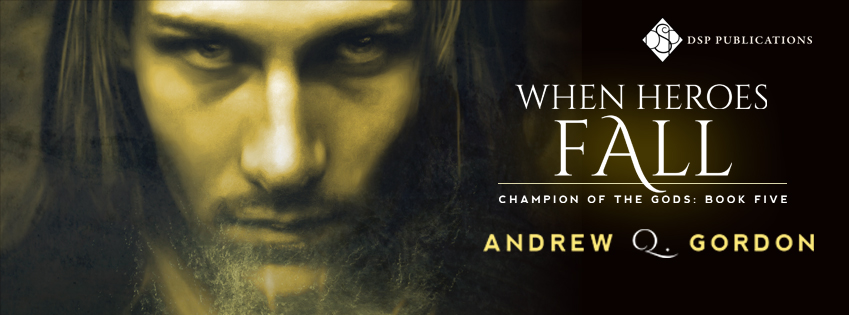
    As the title says, today is release day for When Heroes Fall. (You can find buy links below) I’ve looked forward to this day with anticipation and a touch of sadness. I’m anxious to hear what readers have to say, but I’m also a bit melancholy that it’s over.

    I was searching through my Champion of the Gods folder this week and came upon a file dated 10/26/08. It was a scene from Child of Night and Day. Although the files have been modified, deleted, merged and assumed, I know I began the series before 2006. I know because we moved into our current house in August 2006 and I had already begun the series. 

    As best I can recall, Champions began sometime in 2005. It started with a scene that doesn’t exist anywhere in the series. Chamdon were rushing toward Haven and Miceral was leading a charge of unicorns and Muchari against them. Farrell was back by the twin Sources and his mentors were beside him. He alerted Miceral to break off and as the defenders pulled back, he unleashed as spell to cut down onrushing enemy forces. I couldn’t find that scene when I looked, but I know I saved it on thumb drive. So it’s somewhere.

    Now, after fourteen years, I can finally write “The End” It’s been a long, satisfying journey for me. And if you’re reading this I hope you’ve enjoyed the time spend with Farrell, Miceral, Nerti, Klissmor, Kel, and everyone else. If you have any thoughts or comments on the series, or characters, please leave them below (or email them to me) as I’d love to read them.

    People have already asked about future installments, but I don’t have any plans to start a new series based on this world. Maybe in time something will come to me, but other than going backward and telling Kel’s story, I’m don’t see what’s next for Farrell, Miceral and the others. At least not today, so I won’t say never.

    As always, thanks for being a fan.

    The End!

    Enjoy the journey!

    ~AQG

  • Guest Author: Layla Dorine

    Today we welcome Layla Dorine to the Land of Make Believe. She’s here to tell us about her relationship with her own writing. She’s also going to give you a bit of insight into her upcoming release.

    And with that . . .

    Writing is Personal

    Writing is such a personal thing. I think any writer would tell you the same. That even when you have critique partners and betas and writing groups to bring material to, the process of writing is one of the loneliest feelings in the world. It is also a time for great joy and introspection, at least to me. I find myself recalling things from years and even decades past, drawing on them for character reactions, for events that transpire and even for some moments of comic relief.

    In some of my newest writings, I’ve tackled the subject of going back home after a long absence, and in making one’s own home and family when the places we left behind no longer accept us. In my life I’ve experienced both. Last summer I returned to the place I consider to be my hometown, after fourteen years. So much had changed, but as I walked from one end of the city to the other, it was like I was walking with ghosts.

    My footsteps echoed on the cobblestone that ran in front of the old five story parking garage my best friend and I loved to skateboard through. I could swear I heard him laughing. I could remember the feel of walking arm in arm singing ‘To Be With You,’ the heaviness of the old video camera we used to shoot videos for TV production class, and the scent of fresh clam chowder and fried clam strips.

    The thing I missed the most though, besides family, was the ocean. I could get to it within fifteen minutes from anywhere in the city and loved to spend my free time walking along the sands, picking up shells, or sitting on the break wall, reading a book and writing lyrics.

    I loved getting lost in those magical worlds I created, staring off over the ocean at the horizon, imagining castles rising up from the sea, riding seahorses across the waves and being able to dive to the deepest parts and see all the remarkable animals there. I still haven’t finished that mermaid book I started writing almost ten years ago, but those teenage musings are the basis of it.

    If the places I’ve been and the things I’ve seen are what has shaped me, then I doubt I’ll ever be able to put all of my experiences into words, but I certainly plan to try. I’ve seen forty-seven states now in my forty-two years on this earth, and one thing I’ve learned is how much of an impact new experiences and seeing new things has on me. It’s like lighting a spark that turns into a raging wildfire of words and emotions, and I’ve come to love every minute of it.

    That recent trip home has also given fodder for some backstory to the characters I’ve been creating. Wrapped up in those old memories, was the time my best friend tried to moon a group of us and ended up mooning our high school principal, or the time we took an old van bouncing over some potholes to park it out on the beach, turned the radio up and danced on top of it in the light of the setting sun. Later that night though, that same van started leaking gasoline all down the street and we thought we were going to end up with a fireball when our buddy who owned it went out to take a look while still smoking a cigarette. These are some of the moments that have been woven into even grander tales.

    In my upcoming release, Gypsy’s Rogue, there are several moments from my life spilled out over the page. Like that first night in Chattanooga, looking for Ziggy’s place, Ultra Plague Dog 2000 and getting accosted for my style of dress. Dinner by strands of fairy lights, lying out in a rainstorm until I was soaked, singing country songs in old pickup trucks and coming home from swap meets with a mess of new critters. And if you’ve never seen a city girl try and learn to milk a cow, look out, that one will be showing up in an upcoming book too. Most of Rogue’s reactions to the animals are based off my own. Like the day I walked into the pig confinement I’d just been hired at, took one look at the huge animals and said ‘oh, you have cows here too?’ It took a while to live that down, but man, I never knew pigs could get so big. Naming dinner and skinny dipping in a secluded private pond, bouncing over back roads and dressing up just to go to the mall ‘cause it was the only place around to go to and it was appealing to look nice once in a while.

    I could write more, but I don’t want to give any more away. Just that I’m always searching for new events and looking to make new memories, and hopefully, in time, they get woven in somewhere and I can share them with all of you.

    Peace,

    Layla Dorine

    About Layla

    Layla Dorine lives among the sprawling prairies of Midwestern America, in a house with more cats than people. She loves hiking, fishing, swimming, martial arts, camping out, photography, cooking, and dabbling with several artistic mediums. In addition, she loves to travel and visit museums, historic, and haunted places.

    Layla got hooked on writing as a child, starting with poetry and then branching out, and she hasn’t stopped writing since. Hard times, troubled times, the lives of her characters are never easy, but then what life is? The story is in the struggle, the journey, the triumphs and the falls. She writes about artists, musicians, loners, drifters, dreamers, hippies, bikers, truckers, hunters and all the other folks that she’s met and fallen in love with over the years. Sometimes she writes urban romance and sometimes its aliens crash landing near a roadside bar. When she isn’t writing, or wandering somewhere outdoors, she can often be found curled up with a good book and a kitty on her lap.

    Where To Find Layla

    Website | Publisher | Amazon US| Blog | Facebook | Twitter | Pinterest

  • Guest Author: J. Scott Coatsworth

    Please welcome to the World of Make Believe, award-winning fantasy author, and my friend, J. Scott Coatsworth! I’ve read a number of Scott’s books and recommended him to anyone for whom he is a ‘new to you’ author. Today, despite being a talented, prolific author, he’d like to share a little about what it feels like to be an “Imposter.” Take it away, Scott.!

    I Am an Imposter (And That’s Okay)

    I’m a writer.

    It’s not the only hat I wear, but it is the one most near and dear to my heart. When I don’t write, I feel wrong.

    And yet, I’m also pretty sure I’m also a fraud.

    Ask any writer who’s worth their salt, and they will tell you how often they have these feelings we call “Imposter Syndrome.” No matter how successful you become as an author, no matter how many books you sell or wonderful reviews you get, it only takes one bad one, one reader who calls you out, to make us feel like phonies.

    I’ve literally had ten four and five star reviews for one of my books, and then one reader comes along and says they hated my book, and I’m instantly plunged into the dark pit of despair and sure that I have been found out as an imposter.

    I think it’s because as writers, we are fragile types. We’re dredging up the contents of our souls and splattering them across the page in an act that’s both incredibly intimate and frightening. We expose ourselves in the way of all good artists, both because we have so many stories we want to tell, and because we want people to read them and like them. And maybe even buy them.

    So when someone takes one of these precious bits of our souls and throws it down on the ground to stomp all over it, it hurts, and it exposes our secret shame. We are ever-ready to believe them because we have been brought up to expect a certain level of success from ourselves, from our work – the level that only a few Kings and Rowlings ever achieve – and when we don’t get there (or indeed anywhere close), we tell ourselves that it’s because we are not good enough.

    Not talented enough.

    A fraud.

    An imposter.

    A good writer knows this – indeed, we learn it the hard way. And a good also writer makes peace with it and uses it as a goad to get better.

    I’ve often said when an author thinks they know it all, their art dies. Over the last five years, I’ve learned to accept those moments when my inner critic tells me I’m a fraud, to use them to push me to improve.

    I love to write. I need to write. I am a writing shark, and like the shark, as long as I keep moving, I keep my writing alive.

    I am an imposter. And that’s ok.

    You just might like my work anyway. 🙂

    J. Scott Coatsworth’s Oberon Cycle Series

    Ithani Blurb

    Time is running out.

    After saving the world twice, Xander, Jameson and friends plunge headlong into a new crisis. The ithani–the aliens who broke the world–have reawakened from their hundred millennia-long slumber. When Xander and Jameson disappear in a flash, an already fractured world is thrown into chaos.

    The ithani plans, laid a hundred thousand years before, are finally coming to pass, and they threaten all life on Erro. Venin and Alix go on a desperate search for their missing and find more than they bargained for. And Quince, Robin and Jessa discover a secret as old as the skythane themselves. Will alien technology, unexpected help from the distant past, destiny and some good old-fashioned firepower be enough to defeat an enemy with the power to split a world? The final battle of the epic science fiction adventure that began in Skythane will decide the fate of lander and skythane alike. And in the north, the ithani rise….

    Oberon Cycle Series Blurb

    Oberon is one of the natural wonders of the Universe – a half planet that shouldn’t exist, at least according to the laws of nature.

    Oberon is also a nest of secrets. The Skythane – the first human colonists of Oberon – keep some of them, and so do the “landers” who work for OberCorp, the company that is exploiting the planet for its natural resources.

    Now Oberon is in danger. A solar flare threatens to end most life on the planet, but an ancient prophecy leads Quince, Xander, Jameson and a small group of landers and skythane on an epic quest to save the planet – and unravel its secrets along the way. Other challenges await on the horizon, for the world, and its inhabitants. Will they find the answers they need, and their way to each other, in time?

    Ithani Excerpt

    Venin stood under the dome of the chapel, the waters of the Orn rushing past the small island to crash over the edge of the crater rim, where they fell a thousand meters to the broken city of Errian below.

    The Erriani chapel was different from what he was used to back home. The Gaelani chapel in Gaelan had sat at the top of a tall pillar of stone, open to the night sky, a wide space of grass and trees that intertwined in a natural dome through which moonlight filtered down to make dappled shadows on the ground.

    This chapel, instead, was a wonder of streaming sunlight, the columns a polished eggshell marble with glimmering seams of gold. Red creeper vines climbed up the columns, festooned with clusters of yellow flowers that gave off a sweet scent.

    Both were bright and airy, but the Erriani chapel lay under a dome supported by fluted marble columns, a painted arch of daytime sky and the rose-colored sun blazing overhead.

    The last time he’d gone to chapel had been with Tazim, before his untimely death.

    Long before the troubles that roiled the world now.

    Something drew him back. A need to reconnect with his past. To bridge the gap between then and now, between who he was and who he had become. Taz would have liked this place.

    The chapel here had survived the attack, while much of Errian had not. The city below was a jumble of broken corrinder, the multistory plants that were the main building stock for the city. They would grow again, but the sight of the city’s beautiful white towers laid low struck him to the core.

    So had Gaelan looked, after the flood.

    Venin turned back to the chapel and unlaced his boots, baring his muscular calves before he approached the fountain that splashed at its center. The cool flagstone beneath his feet sent a shiver up his spine, and green moss filled the gaps between the stones.

    Some builder whose name was lost to time had tapped into the river itself to make the fountain run, and the water leapt into the air with a manic energy around the golden statue of Erro, before falling back down to the pool.

    Venin knelt at the fountain’s edge on one of the well-worn pads, laid his hands in the shallow water, and let his wings rest over himself, making a private place to pray.

    Erro and Gael, spare us from danger and lift us up into the sky with your powerful wings. He gave Erro deference, being that this was his chapel, but he hoped Gael would hear him too. The god of his own people had been known to intervene in mortal affairs before, and if what Quince had told them about these ithani was true, they would need all the help they could get.

    Venin’s wings warmed.

    He looked up in astonishment to see the statue of Erro giving off an intense golden glow. His mouth dropped open, and he stood and stared at its beautiful male curves and muscles. Maybe the gods were answering him.

    Venin reached up and touched the statue’s outstretched hand. The shock knocked him backward onto his ass, and he hit the ground hard, slamming into one of the marble columns.

    Venin groaned, stunned, and reached back to feel his wings and spine. He seemed to be in one piece.

    Taz would have laughed his ass off at the whole thing.

    After a moment he sat up cautiously. He wrapped his arms around his legs and stared up at the statue, his chin on his knees.

    The glow was gone.

    Did I imagine it? He stood and felt the back of his head. A lump was already forming there. That’s gonna leave a mark.

    Something had changed. Venin didn’t know what yet, but he was sure of that much.

    He pulled his boots back on and laced them up. With one last suspicious glare at the statue, he turned and stepped out of the chapel, taking a deep breath of the moisture-laden air. Then he leapt into the sky to soar down to the broken city.

    Ithani Buy Links

    Publisher | Amazon eBook | Amazon Paperback | Barnes & Noble | Google Play | Kobo | iTunes

    About J. Scott Coatsworth

    Scott lives between the here and now and the what could be. Indoctrinated into fantasy and sci fi by his mother at the tender age of nine, he devoured her library. But as he grew up, he wondered where the people like him were.

    He decided it was time to create the kinds of stories he couldn’t find at Waldenbooks. If there weren’t gay characters in his favorite genres, he would remake them to his own ends.

    His friends say Scott’s brain works a little differently – he sees relationships between things that others miss, and gets more done in a day than most folks manage in a week. He seeks to transform traditional sci fi, fantasy, and contemporary worlds into something unexpected.

    A Rainbow Award winning author, he runs Queer Sci Fi and QueeRomance Ink with his husband Mark, sites that bring queer people together to promote and celebrate fiction reflecting their own reality.

    Where To Find J. Scott Coatsworth

    Website | Facebook (Personal) | Facebook (Author Page) | Twitter | Goodreads | QueeRomance Ink | Amazon

  • Guest Author: Carole Cummings

    Today, I’m excited to welcome the talented and witty fantasy author (who absolutely did not pay me to say lovely things about her…) Carole Cummings. Carole has a few (OK… more than a few…) words she wanted to share on the importance and intricacies of writing diversity. The floor is all yours, Carole!

    WRITING DIVERSITY FOR (WHITE CIS HET) DUMMIES

    Okay, the title’s a little… smartassy. I couldn’t resist. And it’s not entirely indicative of what I want to talk about. We don’t need another straight white girl’s take on diversity. Diverse communities don’t need me to snag their hashtags out from under them and tell them what they really mean and how they could get what they want if they would just be patient and ask politely. (Seriously, I mean—if a few centuries of asking politely wasn’t working for you, how patient would you be right now?)

    I really just want to talk about why I think every author including diversity in their stories is important and why I wish they #1—would do it, and #2—would do it respectfully, which, granted, means different things to different people, and there’s no one way to go about any of it. So let’s start with one of my own fail—er, teaching moments.

    I began a story once with a Native American protagonist. The details don’t matter, and I didn’t plan to spend much time on the character’s heritage or culture—those things were going to be incidental to the story. One of those “a hero who just happens to be ____ things.” Still, I researched the crap out of the tribe I’d chosen for this character. And I’m not talking “spent a few hours on Wikipedia.” I’m talking years and a good chunk of my research budget before I even opened a blank document.

    But as I researched and read and inquired, I began to suspect that, at least in this case, I couldn’t really create this character without making Rowling’s mistake of trying to be inclusive, but, in fact, undermining the very culture I was trying to include. The history of the tribe I had chosen was too long, too rich, too nuanced, too deeply imbedded in its contemporary members that to not include it as part of the characterization was doing the character a disservice. I could base a character in that culture and then build a fantasy world around it, change enough that I was paying respectful homage to the culture without actually coopting or misrepresenting it. But this was a story that needed to be set in our contemporary world—everything else about the world was anchored in our reality except for the presence of magic—so just pulling the “it’s fiction!” card wasn’t going to cut it.

    So I approached a friend, half of whose genes come from the Mohawk, someone who actually grew up in what he calls “Rez (Reservation) Life.” I was lucky I had someone I could go to, because the conclusion we ended up drawing together was that no, I wasn’t doing it right, I couldn’t do it right without years-long immersion, and if I tried, I might end up doing more harm than good.

    Could I write the character in a way that would satisfy the majority of the readership, more or less “get away with” not getting it right, hand-wave a little bit of “it’s fantasy!” and only worry about the few Native Americans belonging to this particular tribe who might stumble across my story and conclude I’d done it badly? Probably. And you know, it probably wouldn’t have hurt me as an author. That whole “even bad publicity is good publicity” thing is actually true—I’ve seen it. But if I did that, if I wrote something I knew wasn’t right, or worse didn’t care how wrong I got it, what would be the point of including it in the first place?

    So what does a white girl do? Just not write different cultures, different genders, different sexual orientations?

    No, of course not.

    “Write what you know” is the oldest rule in the How to Write book, but it doesn’t mean that if you’re a Catholic Puerto Rican woman from New York, you can only write about Catholic Puerto Rican women from New York. It means you have to connect with your subject, you have to know it back to front, you have to identify with it so closely it leaks out all over the story and ultimately onto the reader.

    The fact that I was unable to grasp all the nuance of a particular culture for a very specific story purpose doesn’t mean I can’t do justice to another. It doesn’t even mean I can’t do justice to that particular culture under different circumstances. The fact that I’m not a guy doesn’t mean I can’t understand every single thought in the head of one of my male characters. The fact that I’m not gay doesn’t mean I can’t write two male protagonists who save the world and eventually end up walking off into the sunset holding hands.

    So what does it mean?

    To me, personally, it means I’d better be very aware of what those of the culture/gender/orientation I’m writing do and do not want in a character before I start typing. That I should know my subjects inside and out before pulling up a blank document, and then get to know them even better as I write.

    For broader purposes, it means when someone says, “We need books with characters of color written by people of color,” I shouldn’t pipe in with, “Hey, #allauthorsmatter, I write characters of color too, y’know!” I should instead be prepared to take a step back and let #ownvoices take the lead. That doesn’t mean hopping off the Diversity Train altogether—it just means acknowledging the fact that I don’t have the background and experience to be the conductor. Respecting my subject doesn’t mean representing it.

    I write speculative fiction. I’m supposed to push envelopes. That’s what speculative fiction does. It removes a problematic subject from its real-world environment, gives it a makeover and turns it into metaphor or allegory, then plops it down into a different world so it can be more objectively analyzed, dissected, sometimes even made less problematic. It does it at a fictional and philosophical distance so that perhaps a reader who is part of the real-world problem can learn their culpability gently and in a way that won’t make them balk and bare their teeth, but will instead make them think and explore and learn. It instills empathy, it forges connections, it has the power to put a reader in the place of a marginalized person and ask “Is this person really that different from you?”

    Those bad guys invading Pandora, viewing the Na’vi as little more than animals and trying to shove aside Hometree so they can get at what they’ve decided is valuable beneath it? That’s us. Put any of Earth’s native peoples in the place of the Na’vi, and Colonel Quaritch is every white explorer/conqueror who walked in and took because he thought he had the right. I know you knew that, but you know what else? As good and beautiful and thought-provoking as that allegory was, you know what’s still problematic about Avatar? The fact that the Na’vi were apparently helpless against Colonel Quaritch and his big, bad machines until Jake came along and led them to victory. Rationalize that however you want, but at the end of the day, it’s still a White Savior story. It’s still Dances with Wolves in space. Imagine how much more impactful that story could have been if the protagonist had been Neytiri or Tsu’tey.

    How are we not past that trope yet? How do we get past it?

    Maybe by just… not writing it anymore. By writing diverse characters from different cultures and backgrounds and histories, and connecting with them, then treating them with the same respect and acceptance we would want to see given to a character that’s supposed to be representative of our own culture, whatever that might be. By not assuming or even insisting that readers can’t or won’t connect with a character unless that character looks like them and comes from a background like theirs. Because if we do our jobs well, if we approach it all with the respect and empathy necessary to forge a connection between character and reader, make the reader care… well. There’s the bulk of our job done well already.

    As authors, we can, yes, write protagonists who are POC even if we’re not. We can write protagonists who are physically challenged, of a different sexuality, who struggle with mental issues, who struggle with emotional issues, who are poor, who are oppressed. We can do it—we can write something that speaks to one, speaks to many, we can write all the above. We can do it as half-assed as we want because that’s our right, because it’s fiction, because my world = my rules, and if we’re willing to accept the potential consequences, we’re not obligated to do it any other way. But if we want to do it well, if we want to help or even just not hurt, we need to find the Author-to-Character-to-Reader connection that will allow us to write our characters’ truths, even when those truths aren’t necessarily ours.

    Include to the very best of our ability, but respect while we’re at it, and remember that we don’t represent. Inclusion isn’t about planting a flag in a culture and claiming it as our own regardless of what the members of that culture might want—it’s about respecting the culture, which means treading a line the citizens of that culture won’t find offensive. And yes, it would help if we figured out if we’re doing that before our story ever sees a submission queue.

    But even when we do all that, we’re not going to please everyone. Because people are different, they have different earned opinions, and just because the majority of a culture might be happy with something we’ve done, it doesn’t mean there won’t still be backlash. It’s the chance we take. It goes with the job of being an author and putting our work out there to be scrutinized, enjoyed, hated, loved.

    Which brings up the real question here—what is an author’s job when it comes right down to it? And if we don’t write with a social conscience, if we don’t try like hell to get it right, if we don’t include diverse characters/genders/etc., are we actually doing that job?

    I submit that in the simplest, most basic terms, our job as authors is to write good stories featuring well-developed characters set in believable worlds, and to make sure those characters stay true to their worlds and circumstances and personalities so that how they feel/think/react rings true. That’s it.

    As human beings, though?

    I would argue it’s… maybe not our job but at least our place to include diverse people in our stories because to not do so is to do a disservice to a good portion of the population. It’s our place to think twice—three times, four—before we drag this world’s faults and prejudices into our fictional worlds like those faults and prejudices are normal and should be accepted as a matter of course. We should do these things because we believe color/sexuality/religion/disability/etc. should not be an excuse to discriminate. We should do them because not doing them makes us part of the problem. And we should do all that with the respect of knowing we’re guests in the culture we’re writing, and that a good guest doesn’t leave their host a big mess to clean up and wishing they’d never met anyone like us.

    It’s not about claiming a hashtag and getting into search engines with the right keywords and boosting sales. It’s not about patting ourselves on the back. It’s about including a diverse cast because the world is made up of diverse people, which means, empirically speaking, other worlds probably would be, too.

    For me, personally, it’s about putting my social politics where my metaphorical mouth is. It’s about this weird little Pollyanna hope that I’m setting some kind of small (okay, tiny) example and that if every author did it and did it conscientiously, diversity would somehow by osmosis become mundane, expected, something that would seep subconsciously into even the most bigoted brain, and the bigot it belonged to would just… stop.

    I know, I know. It’s not that simple. Like I said, it’s totally Pollyanna wishful thinking.

    But on the other hand, I’ve actually seen something like it happen on a smaller scale. I’ve seen homophobic women stumble across slash fanfiction and walk away allies. I’ve seen boys who’ve been taught girls are weak and useless become devotees of Katniss Everdeen. I’ve seen fanboys and fangirls who had meltdowns over Michael B. Jordan daring to play Johnny Storm and who then only a couple years later lined up more than once to watch him steal the Black Panther movie with his frank and nuanced performance as Killmonger.

    Baby steps, yes. But steps. Not enough by a longshot, but that’s not a reason to not do it at all.

    And look, we don’t know what we don’t know. We don’t realize how thick the biased lenses through which we view the world are until someone trots up and taps at them. Maybe we’ve written a character who was more cliché than cultural acknowledgment. Maybe we didn’t know something was an offensive stereotype before we painted our character with its dubious colors. Maybe we just didn’t know, and since we don’t know what we don’t know, we didn’t think to consider an alternative. We didn’t think to ask.

    Know how I figured out I assumed race? By Stephen King treating a character of color as an unremarkably equal cast member in IT. I read that book when I was about… eh, thirteen or so, and I had no idea Mike Hanlon was African American until Henry Bowers called him the n-word a good way into the story. I’d been assuming the entire cast of characters was white because I am. I realized my own gender bias and misconceptions about sexuality when Ursula K. Le Guin very gently rubbed my nose in them in The Left Hand of Darkness.

    I’m sure I have other biases I don’t know about yet because I haven’t yet been confronted with them. And we don’t know what we don’t know. Even when we try, we miss things. We’re human. I don’t think Rowling—a nice, well-intentioned, liberal English lady—had any idea how disrespectful she was being to the Native American community in general, and the Navajo community in particular, when she included a skinwalker legend in her universe. But she could have avoided the controversy that erupted, she could have avoided hurting some of her fans, simply by asking a question of someone who would know. And isn’t part of inclusion not hurting the community we’re including?

    I wrote this essay by committee. I had eleven very kind people from different backgrounds, cultures, orientations, and genders read this thing and give me input because more than anything I didn’t want to come across as condescending or insulting or hurtful. And even after all that, I probably still got something wrong. I have no doubt I’ll find out what once it goes public. (Yikes!) But, you know… I tried. I tried really hard. And if I got something wrong, I’ll try to do better next time.

    Because yes, I’m human, I’m fallible. We all are. We can be dummies sometimes without even realizing it.

    But we’re also learning and evolving, every day, and that’s kind of what we, as human beings, are for. It’s what makes it so much fun to write about us. It’s what makes us interesting. Really, the more diverse we are, the more interesting we get.

    And what author doesn’t want to write something interesting?

    About Carole:

    Carole lives with her husband and family in Pennsylvania, USA, where she spends her time trying to find time to write.  Recipient of various amateur and professional writing awards, several of her short stories have been translated into Spanish, German, Chinese and Polish.

    Author of the Aisling and Wolf’s-own series, Carole is currently in the process of developing several other works, including more short stories than anyone will ever want to read, and novels that turn into series when she’s not looking.

    Carole is an avid reader of just about anything that’s written well and has good characters.  She is a lifelong writer of the ‘movies’ that run constantly in her head.   Surprisingly, she does manage sleep in there somewhere, and though she is rumored to live on coffee and Pixy Stix™, no one has as yet suggested she might be more comfortable in a padded room.

    …Well. Not to her face.

    Where to find Carole:

    Website | Dreamspinner Press | DSP Publications | Amazon | Barnes & Noble| Email| Facebook | Twitter | Blog

  • New Release Blog Tour – Ithani; by J. Scott Coatsworth

    New Release Blog Tour – Ithani; by J. Scott Coatsworth

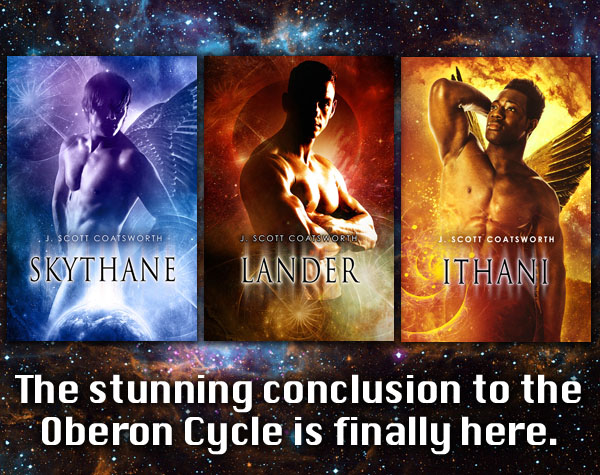
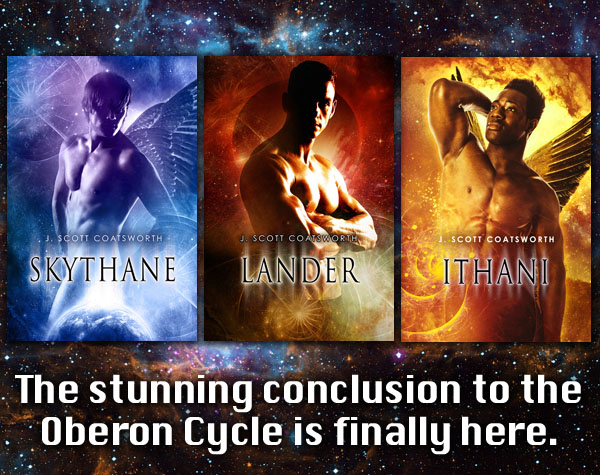
    The final MM sci fi book in J. Scott Coatsworth’s “Oberon Cycle” trilogy is out – “Ithani”!

    Time is running out.

    After saving the world twice, Xander, Jameson and friends plunge headlong into a new crisis. The ithani–the aliens who broke the world–have reawakened from their hundred millennia-long slumber. When Xander and Jameson disappear in a flash, an already fractured world is thrown into chaos.

    The ithani plans, laid a hundred thousand years before, are finally coming to pass, and they threaten all life on Erro. Venin and Alix go on a desperate search for their missing and find more than they bargained for. And Quince, Robin and Jessa discover a secret as old as the skythane themselves.

    Will alien technology, unexpected help from the distant past, destiny and some good old-fashioned firepower be enough to defeat an enemy with the power to split a world? The final battle of the epic science fiction adventure that began in Skythane will decide the fate of lander and skythane alike. And in the north, the ithani rise…

    Oberon Cycle Trilogy

    Ithani Buy Links

    Dreamspinner eBook | Dreamspinner Paperback | Amazon eBook | Amazon Paperback | iBooks | Barnes & Noble | Google Play | Kobo | QueeRomance Ink | Goodreads

    Book 1: Skythane:

    Dreamspinner eBook | Dreamspinner Paperback | Amazon Kindle | Amazon paperback | iBooks | Barnes & Noble | Google Play | Kobo | QueeRomance Ink | Goodreads

    Book Two: Lander:

    Dreamspinner eBook | Dreamspinner Paperback | Amazon Kindle | Amazon Paperback | iBooks | Barnes & Noble | Google Play | Kobo | QueeRomance Ink | Goodreads

    Giveaway

    Scott is giving away a $50 Amazon gift card and ten copies of “The Stark Divide,” the first book in his other trilogy, his other trilogy, “Liminal Sky,” with this tour. Enter via Rafflecopter:

    a Rafflecopter giveaway

    Direct Link: http://www.rafflecopter.com/rafl/display/b60e8d4753/?


    Excerpt

    Venin stood under the dome of the chapel, the waters of the Orn rushing past the small island to crash over the edge of the crater rim, where they fell a thousand meters to the broken city of Errian below.

    The Erriani chapel was different from what he was used to back home. The Gaelani chapel in Gaelan had sat at the top of a tall pillar of stone, open to the night sky, a wide space of grass and trees that intertwined in a natural dome through which moonlight filtered down to make dappled shadows on the ground.

    This chapel, instead, was a wonder of streaming sunlight, the columns a polished eggshell marble with glimmering seams of gold. Red creeper vines climbed up the columns, festooned with clusters of yellow flowers that gave off a sweet scent.

    Both were bright and airy, but the Erriani chapel lay under a dome supported by fluted marble columns, a painted arch of daytime sky and the rose-colored sun blazing overhead.

    The last time he’d gone to chapel had been with Tazim, before his untimely death.

    Long before the troubles that roiled the world now.

    Something drew him back. A need to reconnect with his past. To bridge the gap between then and now, between who he was and who he had become. Taz would have liked this place.

    The chapel here had survived the attack, while much of Errian had not. The city below was a jumble of broken corrinder, the multistory plants that were the main building stock for the city. They would grow again, but the sight of the city’s beautiful white towers laid low struck him to the core.

    So had Gaelan looked, after the flood.

    Venin turned back to the chapel and unlaced his boots, baring his muscular calves before he approached the fountain that splashed at its center. The cool flagstone beneath his feet sent a shiver up his spine, and green moss filled the gaps between the stones.

    Some builder whose name was lost to time had tapped into the river itself to make the fountain run, and the water leapt into the air with a manic energy around the golden statue of Erro, before falling back down to the pool.

    Venin knelt at the fountain’s edge on one of the well-worn pads, laid his hands in the shallow water, and let his wings rest over himself, making a private place to pray.

    Erro and Gael, spare us from danger and lift us up into the sky with your powerful wings. He gave Erro deference, being that this was his chapel, but he hoped Gael would hear him too. The god of his own people had been known to intervene in mortal affairs before, and if what Quince had told them about these ithaniwas true, they would need all the help they could get.

    Venin’s wings warmed.

    He looked up in astonishment to see the statue of Erro giving off an intense golden glow. His mouth dropped open, and he stood and stared at its beautiful male curves and muscles. Maybe the gods were answering him.

    Venin reached up and touched the statue’s outstretched hand. The shock knocked him backward onto his ass, and he hit the ground hard, slamming into one of the marble columns.

    Venin groaned, stunned, and reached back to feel his wings and spine. He seemed to be in one piece.

    Taz would have laughed his ass off at the whole thing.

    After a moment he sat up cautiously. He wrapped his arms around his legs and stared up at the statue, his chin on his knees.

    The glow was gone.

    Did I imagine it? He stood and felt the back of his head. A lump was already forming there. That’s gonna leave a mark.

    Something had changed. Venin didn’t know what yet, but he was sure of that much.

    He pulled his boots back on and laced them up. With one last suspicious glare at the statue, he turned and stepped out of the chapel, taking a deep breath of the moisture-laden air.

    Then he leapt into the sky to soar down to the broken city.


    Author Bio

    Scott lives with his husband of twenty five years in a Sacramento suburb, in a cute little yellow house with a brick fireplace and two pink flamingoes out front.

    He inhabits in the space between the here and now and the what could be. Indoctrinated into science fiction and fantasy by his mom at the tender age of nine, he quickly finished her entire library. But he soon began to wonder where all the queer people were.

    After coming out at twenty three, he started writing the kinds of stories he couldn’t find at Crown Books. If there weren’t many queer characters in his favorite genres, he would will them into existence, subverting them to his own ends. And if he was lucky enough, someone else would want to read them.

    His friends say Scott’s mind works a little differently than most – he makes connections between ideas that others don’t, and somehow does more in a day than most people manage in a week. Although born an introvert, he forced himself to reach outside himself, and learned to connect with others like him.

    Scott’s stories subvert expectations that transform traditional science fiction, fantasy, and contemporary worlds into something different and unexpected. He runs both Queer Sci Fi and QueeRomance Ink with his husband Mark.

    His romance and genre fiction writing brings a queer energy to his stories, filling them with love, beauty and power. He imagines how the world could be – in the process, he hopes to change the world, just a little.

    Scott was recognized as one of the top new gay authors in the 2017 Rainbow Awards, and his debut novel “Skythane” received two awards and an honorable mention.

    You can find him at Dreamspinner here, Goodreads here, on Amazon here, on QueeRomance Ink here, and on Facebook here.

    LOGO - Other Worlds Ink
  • Guest Author: Sarah K. L. Wilson

    Guest Author: Sarah K. L. Wilson

    Today, I am thrilled to welcome USA Today bestselling author Sarah K. L. Wilson to the Land of Make Believe! Sarah is the author of the YA fantasy series Dragon School. This is a wonderful series that I’m starting to share with ‘lil q. With twenty books already out in the series, we’ve got a long adventure ahead of us.

    Sarah has stopped by today to share her delightful perspective on what we should also be seeking to achieve as writers.

    So, without further ado…

    What do you do for a living, Sarah?

    Yesterday, someone asked me what I do for a living.

    “I invent difficult problems and then find inventive solutions,” I said.

    Storytellers through the ages have been inventing problems. How trapped can I make this character? If they find the perfect problem, it makes the best story possible.

    Maybe it’s a cage dangling over a pit of lava – like in the comics I read as a kid – or maybe it’s a cage he has in his own mind. Maybe it’s a deadly form of magic he’s wielding, or a huge test that grinds out heroes and kills the rest.

    Whatever your choice of problem there are two things that must be there: risk and adventure.

    I read a short story about five years ago. I can’t tell you the name of the author or the names of the characters, but I remember the situation. It was a fantastic trap. The characters – I think it was one of those typical adventure parties: an elf, a dwarf, a human – were thrown from trap to trap in a robbery they were committing. Each attempt to grab the treasure only mired them further. It was fantastic. It stuck in my mind like clay on the sole of your boot.

    Even better than interesting problems? Cunning solutions.

    Not just any solution. Not Deus Ex Machina. The very best, most satisfying solution is the one that fits the problem perfectly. The one that stands it on its head. The one that turns the brain teaser from confusing to suddenly clear. The one that finally makes sense of that prophecy that you’ve been turning over in your head for fourteen books. (I’m looking at you, Robert Jordan!)

    That’s not easy to do. But oh, do I love it when a great storyteller pulls it off!

    I think that’s why I fell so hard for Terry Pratchett’s writing when I first read Carpe Jugulum in my teens. What a problem! Vampires loose in the castle! They’ve taken the king. They’ve taken the citizenry. They’ve taken the most powerful witch captive and turned her. How do you solve that problem?

    I’d tell you, but it would hardly be fair to spoil such a great book. Those of you who read it are sipping your tea knowingly and smiling at the answer.

    And that’s what I do, in a nutshell.

    I write interesting fantasy problems. Problems involving magic and betrayal, flying dragons and raging Ifrits, characters with big flaws and bigger hearts.

    And then I solve them. Sometimes elegantly. Sometimes with a metaphorical axe. Always in a way that satisfies.

    Who wouldn’t want that job?

    What’s your job? What interesting problems are you solving for the world? And can you, like a great storyteller, find ways to solve them better?

    I hope that you can.

    I hope that we all can.

    Sarah K. L. Wilson is the bestselling author of Dragon School, a young adult fantasy series. You can find out more about her interesting problems and solutions at www.sarahklwilson.com  or join her fans in Discord for the real fun.