Category: Uncategorized

  • Guest Author: Layla Dorine

    Today we welcome Layla Dorine to the Land of Make Believe. She’s here to tell us about her relationship with her own writing. She’s also going to give you a bit of insight into her upcoming release.

    And with that . . .

    Writing is Personal

    Writing is such a personal thing. I think any writer would tell you the same. That even when you have critique partners and betas and writing groups to bring material to, the process of writing is one of the loneliest feelings in the world. It is also a time for great joy and introspection, at least to me. I find myself recalling things from years and even decades past, drawing on them for character reactions, for events that transpire and even for some moments of comic relief.

    In some of my newest writings, I’ve tackled the subject of going back home after a long absence, and in making one’s own home and family when the places we left behind no longer accept us. In my life I’ve experienced both. Last summer I returned to the place I consider to be my hometown, after fourteen years. So much had changed, but as I walked from one end of the city to the other, it was like I was walking with ghosts.

    My footsteps echoed on the cobblestone that ran in front of the old five story parking garage my best friend and I loved to skateboard through. I could swear I heard him laughing. I could remember the feel of walking arm in arm singing ‘To Be With You,’ the heaviness of the old video camera we used to shoot videos for TV production class, and the scent of fresh clam chowder and fried clam strips.

    The thing I missed the most though, besides family, was the ocean. I could get to it within fifteen minutes from anywhere in the city and loved to spend my free time walking along the sands, picking up shells, or sitting on the break wall, reading a book and writing lyrics.

    I loved getting lost in those magical worlds I created, staring off over the ocean at the horizon, imagining castles rising up from the sea, riding seahorses across the waves and being able to dive to the deepest parts and see all the remarkable animals there. I still haven’t finished that mermaid book I started writing almost ten years ago, but those teenage musings are the basis of it.

    If the places I’ve been and the things I’ve seen are what has shaped me, then I doubt I’ll ever be able to put all of my experiences into words, but I certainly plan to try. I’ve seen forty-seven states now in my forty-two years on this earth, and one thing I’ve learned is how much of an impact new experiences and seeing new things has on me. It’s like lighting a spark that turns into a raging wildfire of words and emotions, and I’ve come to love every minute of it.

    That recent trip home has also given fodder for some backstory to the characters I’ve been creating. Wrapped up in those old memories, was the time my best friend tried to moon a group of us and ended up mooning our high school principal, or the time we took an old van bouncing over some potholes to park it out on the beach, turned the radio up and danced on top of it in the light of the setting sun. Later that night though, that same van started leaking gasoline all down the street and we thought we were going to end up with a fireball when our buddy who owned it went out to take a look while still smoking a cigarette. These are some of the moments that have been woven into even grander tales.

    In my upcoming release, Gypsy’s Rogue, there are several moments from my life spilled out over the page. Like that first night in Chattanooga, looking for Ziggy’s place, Ultra Plague Dog 2000 and getting accosted for my style of dress. Dinner by strands of fairy lights, lying out in a rainstorm until I was soaked, singing country songs in old pickup trucks and coming home from swap meets with a mess of new critters. And if you’ve never seen a city girl try and learn to milk a cow, look out, that one will be showing up in an upcoming book too. Most of Rogue’s reactions to the animals are based off my own. Like the day I walked into the pig confinement I’d just been hired at, took one look at the huge animals and said ‘oh, you have cows here too?’ It took a while to live that down, but man, I never knew pigs could get so big. Naming dinner and skinny dipping in a secluded private pond, bouncing over back roads and dressing up just to go to the mall ‘cause it was the only place around to go to and it was appealing to look nice once in a while.

    I could write more, but I don’t want to give any more away. Just that I’m always searching for new events and looking to make new memories, and hopefully, in time, they get woven in somewhere and I can share them with all of you.

    Peace,

    Layla Dorine

    About Layla

    Layla Dorine lives among the sprawling prairies of Midwestern America, in a house with more cats than people. She loves hiking, fishing, swimming, martial arts, camping out, photography, cooking, and dabbling with several artistic mediums. In addition, she loves to travel and visit museums, historic, and haunted places.

    Layla got hooked on writing as a child, starting with poetry and then branching out, and she hasn’t stopped writing since. Hard times, troubled times, the lives of her characters are never easy, but then what life is? The story is in the struggle, the journey, the triumphs and the falls. She writes about artists, musicians, loners, drifters, dreamers, hippies, bikers, truckers, hunters and all the other folks that she’s met and fallen in love with over the years. Sometimes she writes urban romance and sometimes its aliens crash landing near a roadside bar. When she isn’t writing, or wandering somewhere outdoors, she can often be found curled up with a good book and a kitty on her lap.

    Where To Find Layla

    Website | Publisher | Amazon US| Blog | Facebook | Twitter | Pinterest

  • Guest Author: Carole Cummings

    Today, I’m excited to welcome the talented and witty fantasy author (who absolutely did not pay me to say lovely things about her…) Carole Cummings. Carole has a few (OK… more than a few…) words she wanted to share on the importance and intricacies of writing diversity. The floor is all yours, Carole!

    WRITING DIVERSITY FOR (WHITE CIS HET) DUMMIES

    Okay, the title’s a little… smartassy. I couldn’t resist. And it’s not entirely indicative of what I want to talk about. We don’t need another straight white girl’s take on diversity. Diverse communities don’t need me to snag their hashtags out from under them and tell them what they really mean and how they could get what they want if they would just be patient and ask politely. (Seriously, I mean—if a few centuries of asking politely wasn’t working for you, how patient would you be right now?)

    I really just want to talk about why I think every author including diversity in their stories is important and why I wish they #1—would do it, and #2—would do it respectfully, which, granted, means different things to different people, and there’s no one way to go about any of it. So let’s start with one of my own fail—er, teaching moments.

    I began a story once with a Native American protagonist. The details don’t matter, and I didn’t plan to spend much time on the character’s heritage or culture—those things were going to be incidental to the story. One of those “a hero who just happens to be ____ things.” Still, I researched the crap out of the tribe I’d chosen for this character. And I’m not talking “spent a few hours on Wikipedia.” I’m talking years and a good chunk of my research budget before I even opened a blank document.

    But as I researched and read and inquired, I began to suspect that, at least in this case, I couldn’t really create this character without making Rowling’s mistake of trying to be inclusive, but, in fact, undermining the very culture I was trying to include. The history of the tribe I had chosen was too long, too rich, too nuanced, too deeply imbedded in its contemporary members that to not include it as part of the characterization was doing the character a disservice. I could base a character in that culture and then build a fantasy world around it, change enough that I was paying respectful homage to the culture without actually coopting or misrepresenting it. But this was a story that needed to be set in our contemporary world—everything else about the world was anchored in our reality except for the presence of magic—so just pulling the “it’s fiction!” card wasn’t going to cut it.

    So I approached a friend, half of whose genes come from the Mohawk, someone who actually grew up in what he calls “Rez (Reservation) Life.” I was lucky I had someone I could go to, because the conclusion we ended up drawing together was that no, I wasn’t doing it right, I couldn’t do it right without years-long immersion, and if I tried, I might end up doing more harm than good.

    Could I write the character in a way that would satisfy the majority of the readership, more or less “get away with” not getting it right, hand-wave a little bit of “it’s fantasy!” and only worry about the few Native Americans belonging to this particular tribe who might stumble across my story and conclude I’d done it badly? Probably. And you know, it probably wouldn’t have hurt me as an author. That whole “even bad publicity is good publicity” thing is actually true—I’ve seen it. But if I did that, if I wrote something I knew wasn’t right, or worse didn’t care how wrong I got it, what would be the point of including it in the first place?

    So what does a white girl do? Just not write different cultures, different genders, different sexual orientations?

    No, of course not.

    “Write what you know” is the oldest rule in the How to Write book, but it doesn’t mean that if you’re a Catholic Puerto Rican woman from New York, you can only write about Catholic Puerto Rican women from New York. It means you have to connect with your subject, you have to know it back to front, you have to identify with it so closely it leaks out all over the story and ultimately onto the reader.

    The fact that I was unable to grasp all the nuance of a particular culture for a very specific story purpose doesn’t mean I can’t do justice to another. It doesn’t even mean I can’t do justice to that particular culture under different circumstances. The fact that I’m not a guy doesn’t mean I can’t understand every single thought in the head of one of my male characters. The fact that I’m not gay doesn’t mean I can’t write two male protagonists who save the world and eventually end up walking off into the sunset holding hands.

    So what does it mean?

    To me, personally, it means I’d better be very aware of what those of the culture/gender/orientation I’m writing do and do not want in a character before I start typing. That I should know my subjects inside and out before pulling up a blank document, and then get to know them even better as I write.

    For broader purposes, it means when someone says, “We need books with characters of color written by people of color,” I shouldn’t pipe in with, “Hey, #allauthorsmatter, I write characters of color too, y’know!” I should instead be prepared to take a step back and let #ownvoices take the lead. That doesn’t mean hopping off the Diversity Train altogether—it just means acknowledging the fact that I don’t have the background and experience to be the conductor. Respecting my subject doesn’t mean representing it.

    I write speculative fiction. I’m supposed to push envelopes. That’s what speculative fiction does. It removes a problematic subject from its real-world environment, gives it a makeover and turns it into metaphor or allegory, then plops it down into a different world so it can be more objectively analyzed, dissected, sometimes even made less problematic. It does it at a fictional and philosophical distance so that perhaps a reader who is part of the real-world problem can learn their culpability gently and in a way that won’t make them balk and bare their teeth, but will instead make them think and explore and learn. It instills empathy, it forges connections, it has the power to put a reader in the place of a marginalized person and ask “Is this person really that different from you?”

    Those bad guys invading Pandora, viewing the Na’vi as little more than animals and trying to shove aside Hometree so they can get at what they’ve decided is valuable beneath it? That’s us. Put any of Earth’s native peoples in the place of the Na’vi, and Colonel Quaritch is every white explorer/conqueror who walked in and took because he thought he had the right. I know you knew that, but you know what else? As good and beautiful and thought-provoking as that allegory was, you know what’s still problematic about Avatar? The fact that the Na’vi were apparently helpless against Colonel Quaritch and his big, bad machines until Jake came along and led them to victory. Rationalize that however you want, but at the end of the day, it’s still a White Savior story. It’s still Dances with Wolves in space. Imagine how much more impactful that story could have been if the protagonist had been Neytiri or Tsu’tey.

    How are we not past that trope yet? How do we get past it?

    Maybe by just… not writing it anymore. By writing diverse characters from different cultures and backgrounds and histories, and connecting with them, then treating them with the same respect and acceptance we would want to see given to a character that’s supposed to be representative of our own culture, whatever that might be. By not assuming or even insisting that readers can’t or won’t connect with a character unless that character looks like them and comes from a background like theirs. Because if we do our jobs well, if we approach it all with the respect and empathy necessary to forge a connection between character and reader, make the reader care… well. There’s the bulk of our job done well already.

    As authors, we can, yes, write protagonists who are POC even if we’re not. We can write protagonists who are physically challenged, of a different sexuality, who struggle with mental issues, who struggle with emotional issues, who are poor, who are oppressed. We can do it—we can write something that speaks to one, speaks to many, we can write all the above. We can do it as half-assed as we want because that’s our right, because it’s fiction, because my world = my rules, and if we’re willing to accept the potential consequences, we’re not obligated to do it any other way. But if we want to do it well, if we want to help or even just not hurt, we need to find the Author-to-Character-to-Reader connection that will allow us to write our characters’ truths, even when those truths aren’t necessarily ours.

    Include to the very best of our ability, but respect while we’re at it, and remember that we don’t represent. Inclusion isn’t about planting a flag in a culture and claiming it as our own regardless of what the members of that culture might want—it’s about respecting the culture, which means treading a line the citizens of that culture won’t find offensive. And yes, it would help if we figured out if we’re doing that before our story ever sees a submission queue.

    But even when we do all that, we’re not going to please everyone. Because people are different, they have different earned opinions, and just because the majority of a culture might be happy with something we’ve done, it doesn’t mean there won’t still be backlash. It’s the chance we take. It goes with the job of being an author and putting our work out there to be scrutinized, enjoyed, hated, loved.

    Which brings up the real question here—what is an author’s job when it comes right down to it? And if we don’t write with a social conscience, if we don’t try like hell to get it right, if we don’t include diverse characters/genders/etc., are we actually doing that job?

    I submit that in the simplest, most basic terms, our job as authors is to write good stories featuring well-developed characters set in believable worlds, and to make sure those characters stay true to their worlds and circumstances and personalities so that how they feel/think/react rings true. That’s it.

    As human beings, though?

    I would argue it’s… maybe not our job but at least our place to include diverse people in our stories because to not do so is to do a disservice to a good portion of the population. It’s our place to think twice—three times, four—before we drag this world’s faults and prejudices into our fictional worlds like those faults and prejudices are normal and should be accepted as a matter of course. We should do these things because we believe color/sexuality/religion/disability/etc. should not be an excuse to discriminate. We should do them because not doing them makes us part of the problem. And we should do all that with the respect of knowing we’re guests in the culture we’re writing, and that a good guest doesn’t leave their host a big mess to clean up and wishing they’d never met anyone like us.

    It’s not about claiming a hashtag and getting into search engines with the right keywords and boosting sales. It’s not about patting ourselves on the back. It’s about including a diverse cast because the world is made up of diverse people, which means, empirically speaking, other worlds probably would be, too.

    For me, personally, it’s about putting my social politics where my metaphorical mouth is. It’s about this weird little Pollyanna hope that I’m setting some kind of small (okay, tiny) example and that if every author did it and did it conscientiously, diversity would somehow by osmosis become mundane, expected, something that would seep subconsciously into even the most bigoted brain, and the bigot it belonged to would just… stop.

    I know, I know. It’s not that simple. Like I said, it’s totally Pollyanna wishful thinking.

    But on the other hand, I’ve actually seen something like it happen on a smaller scale. I’ve seen homophobic women stumble across slash fanfiction and walk away allies. I’ve seen boys who’ve been taught girls are weak and useless become devotees of Katniss Everdeen. I’ve seen fanboys and fangirls who had meltdowns over Michael B. Jordan daring to play Johnny Storm and who then only a couple years later lined up more than once to watch him steal the Black Panther movie with his frank and nuanced performance as Killmonger.

    Baby steps, yes. But steps. Not enough by a longshot, but that’s not a reason to not do it at all.

    And look, we don’t know what we don’t know. We don’t realize how thick the biased lenses through which we view the world are until someone trots up and taps at them. Maybe we’ve written a character who was more cliché than cultural acknowledgment. Maybe we didn’t know something was an offensive stereotype before we painted our character with its dubious colors. Maybe we just didn’t know, and since we don’t know what we don’t know, we didn’t think to consider an alternative. We didn’t think to ask.

    Know how I figured out I assumed race? By Stephen King treating a character of color as an unremarkably equal cast member in IT. I read that book when I was about… eh, thirteen or so, and I had no idea Mike Hanlon was African American until Henry Bowers called him the n-word a good way into the story. I’d been assuming the entire cast of characters was white because I am. I realized my own gender bias and misconceptions about sexuality when Ursula K. Le Guin very gently rubbed my nose in them in The Left Hand of Darkness.

    I’m sure I have other biases I don’t know about yet because I haven’t yet been confronted with them. And we don’t know what we don’t know. Even when we try, we miss things. We’re human. I don’t think Rowling—a nice, well-intentioned, liberal English lady—had any idea how disrespectful she was being to the Native American community in general, and the Navajo community in particular, when she included a skinwalker legend in her universe. But she could have avoided the controversy that erupted, she could have avoided hurting some of her fans, simply by asking a question of someone who would know. And isn’t part of inclusion not hurting the community we’re including?

    I wrote this essay by committee. I had eleven very kind people from different backgrounds, cultures, orientations, and genders read this thing and give me input because more than anything I didn’t want to come across as condescending or insulting or hurtful. And even after all that, I probably still got something wrong. I have no doubt I’ll find out what once it goes public. (Yikes!) But, you know… I tried. I tried really hard. And if I got something wrong, I’ll try to do better next time.

    Because yes, I’m human, I’m fallible. We all are. We can be dummies sometimes without even realizing it.

    But we’re also learning and evolving, every day, and that’s kind of what we, as human beings, are for. It’s what makes it so much fun to write about us. It’s what makes us interesting. Really, the more diverse we are, the more interesting we get.

    And what author doesn’t want to write something interesting?

    About Carole:

    Carole lives with her husband and family in Pennsylvania, USA, where she spends her time trying to find time to write.  Recipient of various amateur and professional writing awards, several of her short stories have been translated into Spanish, German, Chinese and Polish.

    Author of the Aisling and Wolf’s-own series, Carole is currently in the process of developing several other works, including more short stories than anyone will ever want to read, and novels that turn into series when she’s not looking.

    Carole is an avid reader of just about anything that’s written well and has good characters.  She is a lifelong writer of the ‘movies’ that run constantly in her head.   Surprisingly, she does manage sleep in there somewhere, and though she is rumored to live on coffee and Pixy Stix™, no one has as yet suggested she might be more comfortable in a padded room.

    …Well. Not to her face.

    Where to find Carole:

    Website | Dreamspinner Press | DSP Publications | Amazon | Barnes & Noble| Email| Facebook | Twitter | Blog

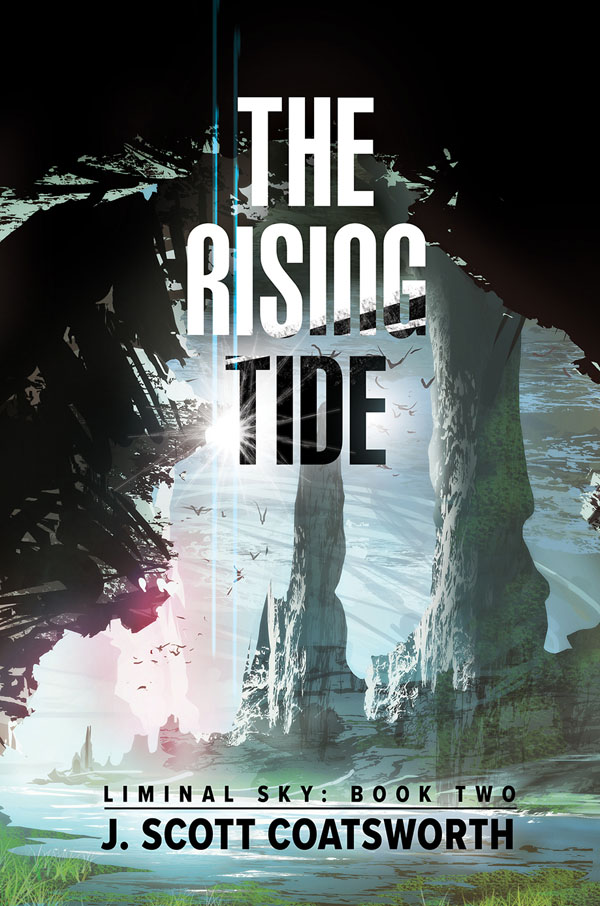
  • Blog Tour – The Rising Tide – By J. Scott Coatsworth

    Blog Tour – The Rising Tide – By J. Scott Coatsworth

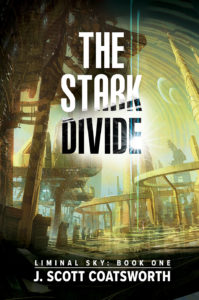
    Today Scott Coatsworth stops by to share his newest release, The Rising Tide, the second book in his Liminal Sky series. If you haven’t read, the first book in the series, The Stark Divide, you really need to read that first. More to the point – if you haven’t read it, you should! This is a great series. And now for something completely different.


    The Rising Tide

    J. Scott Coatsworth has a new queer sci fi book out: “The Rising Tide.”

    Earth is dead.

    Five years later, the remnants of humanity travel through the stars inside Forever, a living, ever-evolving, self-contained generation ship. When Eddy Tremaine and Andy Hammond find a hidden world-within-a-world under the mountains, the discovery triggers a chain of events that could fundamentally alter or extinguish life as they know it, culminate in the takeover of the world mind, and end free will for humankind.

    Control the AI, control the people.

    Eddy, Andy, and a handful of other unlikely heroes—people of every race and identity, and some who aren’t even human—must find the courage and ingenuity to stand against the rising tide.

    Otherwise they might be living through the end days of human history.

    Series Blurb: Humankind is on its way to the stars, a journey that will change it forever. Each of the stories in Liminal Sky explores that future through the lens of a generation ship, where the line between science fiction and fantasy often blurs. At times both pessimistic and very hopeful, Liminal Sky thrusts you into a future few would ever have imagined.

    DSP Publications | Amazon | iBooks | Barnes & Noble | Kobo | QueeRomance Ink | Goodreads


    Giveaway

    Scott is giving away two prizes with this tour – a $25 Amazon gift card, and a signed copy of “The Stark Divide,” book one in the series (US winner only for the paperback). For a chance to win, enter via Rafflecopter:

    a Rafflecopter giveaway

    Direct Link: http://www.rafflecopter.com/rafl/display/b60e8d4734/?


    Excerpt

    The Rising Tide Meme

    Eddy Tremayne rode his horse, Cassiopeia, along the edge of the pastures that were the last official human habitations before the Anatov Mountains. Several ranchers along the Verge—the zone between the ranches and the foothills—had reported losses of sheep and cattle in the last few weeks.

    As the elected sheriff of First District, which ran from Micavery and the South Pole to the mountains, it was Eddy’s responsibility to find out what was going on.

    He had his crossbow strapped to his back and his long knife in a leather sheath at his waist. He’d been carrying them for long enough now—three years?—that they had started to feel natural, but the first time he’d worn the crossbow, he’d felt like a poor man’s Robin Hood.

    He doubted he’d need them out here, but sheriffs were supposed to be armed.

    He’d checked with Lex in the world mind via the South Pole terminal, but she’d reported nothing amiss. In the last few years, she had begun to deploy biodrones to keep an eye on the far-flung parts of the world, but they provided less than optimal coverage. One flyover of this part of the Verge had shown a peaceful flock of thirty sheep. The next showed eight.

    The rancher, a former neurosurgeon from New Zealand named Gia Rand, waited for him on the top of a grassy hill. The grass and trees shone with bioluminescent light, and the afternoon sky lit the surrounding countryside with a golden glow. The spindle—the aggregation of energy and glowing pollen that stretched from pole to pole—sparkled in the middle of the sky.

    The rancher pulled on her gray braid, staring angrily at something in the valley below. “Took you long enough to get here.”

    “Sorry. The train was out of service again.” Technology was slowly failing them, and they had yet to come up with good replacements.

    She snorted. “One helluva spaceship we have here.”

    He grinned. “Preaching to the choir.” Forever didn’t have the manufacturing base yet to support anything close to the technology its inhabitants had grown used to on Earth. Which wasn’t necessarily a bad thing, if you asked him. With technology came new and better ways to kill. He’d seen it often enough in the NAU Marines. “What did you find?”

    “Look.” Her voice was almost a growl.

    Eddy looked down where she was pointing. “Oh shit.” Her missing sheep were no longer missing. They had been slaughtered.

    He urged Cassiopeia down the hillside to the rocky clearing. A small stream trickled down out of the mountains there. He counted ten carcasses, as near as he could tell from the skulls left behind. Someone had sheared a couple of them and given up. It looked like they had skinned and cut the rest up for meat, the skin and bones and extra bits discarded.

    Gia rode down the hillside behind him.

    “Didn’t you report twelve sheep missing?”

    She nodded. “Bastards took the two lambs. Probably for breeding.”

    “That actually might help us.”

    “How’s that?”

    He dismounted to take a closer look at the crime scene. “They’ll have to pasture them somewhere. May make it easier to track them down.”

    “Maybe so.” She dismounted and joined him. “This was brutal work. Look here.” She picked up a bone. “Whatever cut this was sharp but uneven. It left scratch marks across the bone.”

    “So not a metal knife.”

    “I don’t think so. Maybe a stone knife?”

    He laughed harshly. “Are we back to caveman days, then?” It wasn’t an unreasonable question.

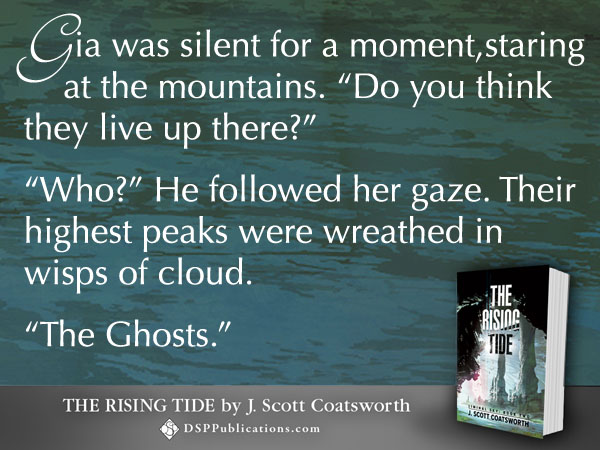
    She was silent for a moment, staring at the mountains. “Do you think they live up there?”

    “Who?” He followed her gaze. Their highest peaks were wreathed in wisps of cloud.

    “The Ghosts.”

    The Ghosts had been a persistent myth on Forever since their abrupt departure from Earth. Some of the refugees had vanished right after the Collapse, and every now and then something would end up missing. Clothes off a line, food stocks, and the like.

    People talked. The rumors had taken on a life of their own, and now whenever something went missing, people whispered, “It’s the Ghosts.”

    Eddy didn’t believe in ghosts. He personally knew at least one refugee who had disappeared, his shipmate Davian. He guessed there must be others, though the record keeping from that time had been slipshod at best. He shrugged and looked at the sky. “Who knows?” It was likely to rain in the next day or so. Whoever had done this had left a trail, trampled into the grass. If he didn’t follow it now, it might be gone by the time he got back here with more resources.

    Gia knelt by one of the ewes, staring at the remnants of the slaughter. “Could you get me some more breeding stock? This… incident put a big dent in my herd.”

    “I’ll see what I can do.” He took one last look around the site. It had to have taken an hour or two to commit this crime, and yet the thieves had apparently done it in broad daylight. Why weren’t they afraid of being caught? “I’m going to follow the trail, see where it leads.”

    Gia nodded. “Thanks. We’re taking the rest of the herd back to the barn until you get this all figured out.”

    “Sounds prudent. I’ll let you know.”

    Slipping on his hat, he climbed back up on Cassie and followed the trail across the stream toward the Anatov Mountains.


    Author Bio

    Scott lives between the here and now and the what could be. Indoctrinated into fantasy and sci fi by his mother at the tender age of nine, he devoured her library. But as he grew up, he wondered where the people like him were.

    He decided it was time to create the kinds of stories he couldn’t find at Waldenbooks. If there weren’t gay characters in his favorite genres, he would remake them to his own ends.

    His friends say Scott’s brain works a little differently – he sees relationships between things that others miss, and gets more done in a day than most folks manage in a week. He seeks to transform traditional sci fi, fantasy, and contemporary worlds into something unexpected.

    A Rainbow Award winning author, he runs Queer Sci Fi and QueeRomance Ink with his husband Mark, sites that bring queer people together to promote and celebrate fiction reflecitng their own reality.

    Website: https://www.jscottcoatsworth.com

    Facebook (Personal): https://www.facebook.com/jscottcoatsworth

    Facebook (Author Page): https://www.facebook.com/jscottcoatsworthauthor/

    Twitter: https://twitter.com/jscoatsworth

    Goodreads: https://www.goodreads.com/author/show/8392709.J_Scott_Coatsworth

    QueeRomance Ink: https://www.queeromanceink.com/mbm-book-author/j-scott-coatsworth/

    Author Amazon: https://www.amazon.com/J.-Scott-Coatsworth/e/B011AFO4OQ/

    LOGO - Other Worlds Ink

  • October Out Of This World Sci-Fi & Fantasy Giveaway

    October Out Of This World Sci-Fi & Fantasy Giveaway

    I don’t join a lot of giveaways, but this one seemed like a good event for my readers. Not only can you score a bunch of new-to-you Sci-fi and/or Fantasy books, there is a contest for a pretty cool prize pack.

    Click the banner below to download some free books and enter the giveaway.

    Out of this World October Giveaway


    If you prefer to just look at the free books – though I don’t know why you wouldn’t want to enter the contest – here is a link to just the book download page:

    https://books.bookfunnel.com/bybbscififant/ju0dtvp19d


  • Blog Tour: grydscaen: beginnings by Natsuya Uesugi

    Today please welcome Natsuya Uesugi to the Land of Make Believe. I haven’t hosted a lot of authors lately, but Natsuya’s books intrigued me that I signed up for his tour. After poking around his site and looking at his books, I’m glad I did. If you’re looking for something a bit different, read on to find out more. I think you’ll be glad you did.

    ~AQG

    Author Interview: Natsuya Uesugi

    How long on average does it take you to write a book?

    I can write a book in a month. The longest I think I have taken is six months, the shortest for a full length novel is a week. I usually try to stay around a month when I am writing the scifi grydscaen series. If I am writing fantasy I do take a little longer as the world building for me in fantasy I find different in scifi and it takes more details. The grydscaen world is fully flushed out as I have been living with the story since the eighth grade and have had time to really perfect the world and put in the extra details. So I guess you can say I average about a month for a novel.

    What do you do if you get a brilliant idea at a bad time?

    I have an app on my smart phone that I will write notes in and come back and use that later maybe in a story or I am currently writing a free online scifi blog series called “grydscaen: darkness” set in the grydscaen world that takes place after the novel grydscaen: dark. I take notes on stories and then use those notes from my phone when I can be somewhere to sit down and write. Other times like I just updated the subway map for the current book “grydscaen: beginnings.” I couldn’t put the map in the phone since I hadn’t drawn it yet but I did use the phone to check out the New York City subway, the London Underground and the Washington DC subway map. I also looked at the Tokyo Subway and Shinkansen in Japan. I loaded those apps on my phone and was able to refer to them when I updated my grydscaen subway map for the book. Never wrote a book on the phone yet, but I might try that sometime in the future.

    Why did you choose to write in your particular field or genre? If you write more than one, how do you balance them?

    I work as a systems analyst in technology and I have worked as a hacker and a human factors engineer making UI designs and websites, and I have been a programmer. The story at the heart of grydscaen with its clandestine psychic operatives, nuclear war, and Zone Police, is really about hackers against the government. This is what I know. I have worked on jet fighter contracts for the government, hacked into systems for my company, and developed software. So I know a little about technology and I use that in my scifi. I also write fantasy and yaoi. I had some fantasy characters in mind since high school so I had to get that out there, and I like yaoi manga and anime so I wanted to lend my pen to that genre as well.

    How long have you been writing?

    Been writing since the third grade when I wrote a story that won a ribbon in a competition. I always found writing rewarding. I am a quiet person with a very small group of close friends. I write and I work and draw my original manga. So writing for me is both a past time and a way to express myself when I am not drawing. The first actual character design I drew for grydscaen was in the eighth grade and then the main character Lino Dejarre I wrote into another story and created a whole comic book around him in the seventh grade. Lino was not originally in grydscaen but now he is the main character in the story. So I have been writing for it seems forever and I don’t plan to stop.

    Are there underrepresented groups or ideas featured if your book? If so, discuss them.

    I make sure to have bisexual, transgender and non-binary characters in my stories as well as other diverse groups such as Native American and Asian characters and People of Colour. This is important for me because I ended up in grydscaen writing the books and the characters that were diverse that I could not find freshman year in college. I guess I filled in the gap I saw in books while I was in college and exploring my own gender identity and sexuality. I am Black and Native American and Japanese, there were no characters like that in books that I could find in college. Now I am actually writing my yaoi story with the amateur manga artist Noiz who is Native American and Japanese. I want to make sure young people can find themselves in literature and in order to do that I showcase diversity.

    Tell us something we don’t know about your heroes. What makes them tick?

    Lets talk about Naito Sennish the bisexual character in the grydscaen story. He is driven by beauty and personality. His personality is big and he is egotistical. He came from a privileged upbringing in the utopian City and gave it all up and abandoned his home, his trust fund and his family and friends to become a cyber terrorist in the slum-level Echelons and fight against the government. What drives him is his idea of right and wrong. He has a black and white view. He is right and the government is oppressive and wrong. Citizens in the City are wrong. The underprivileged in the Echelons who are being oppressed and manipulated by propaganda on the newsfeed are right. His black and white world is what drives him. You are either with him or you are not. He judges people quickly and if they don’t fit into his view then he will drop you quick. His sexuality is also like that. He goes for beauty and be it a man or a woman, the personality and the “feeling at first sight” is what makes him gravitate towards someone or not. Naito is bisexual and he is who he is. Even as the writer, he won’t let me change him. I have tried and if I do he writes me into a corner and I have to pull him out of there or otherwise he and the story do not cooperate.

    What was the hardest part of writing this book?

    The hardest part of writing this book for me was getting all the locations in the story in the right place, grydscaen: beginnings is futuristic scifi based on your original world in 2055. I needed to create two maps for grydscaen a subway map of the City, the Echelons and the Zone and a world map when the battles start between the Atlantea Federation and the insurgent Pacific Territories. The locations on the subway map were mentioned in the grydscaen: beginnings story but when the subway station stops were drawn into the map they needed to be in the right place in the right order to fit with the story. The subway map was pretty easy to conceptualize, but the world map, I had to move locations more than once on that final map to get everything where it needed to be. In the grydscaen subway map, it takes a hint from the New York City subway and streets in Soho, as well as the Tokyo subway. Also I am a pantser so sometimes the plot in the rough draft veers off which has to then get tamed in edits. That can be frustrating because a rewrite of something in the middle can change the dynamic of the ending and that can end up changing the whole story. I had to actually move streets in the Echelons on the map to get the visual to match the story.

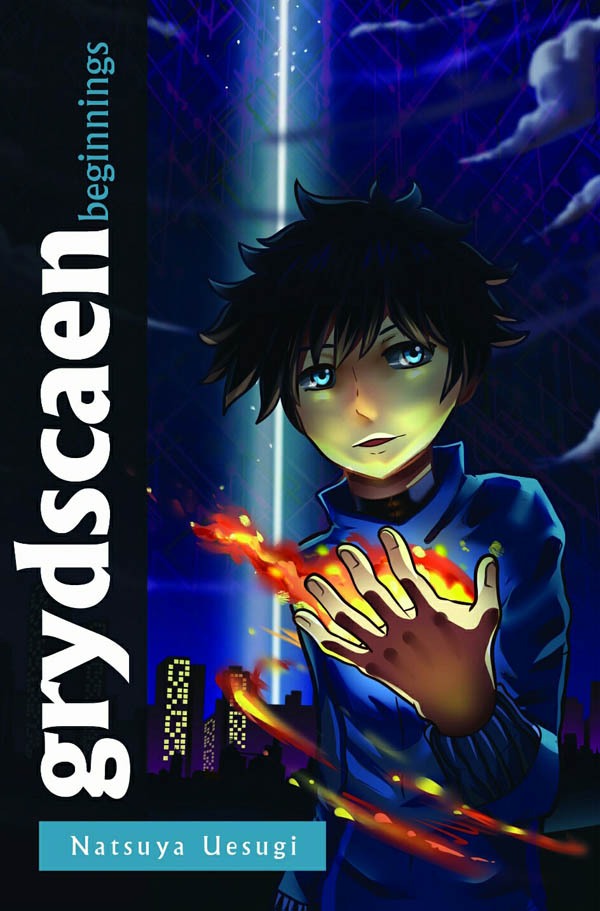
    grydscaen: beginnings
    Natsuya Uesugi has a new queer sci fi book out:

    Faid Callen is tired of life on the run in the Echelons trying to keep his psychic power in check. He founds the Packrats, a group of cyberterrorist hackers. A young powerful Psi Faction operative, Lino Dejarre, is sent on a mission to capture Faid. Wanting to keep Lino under control, the Psi Faction kidnaps his half-brother, Riuho, and they take him prisoner, experiment on him, train him, and subject him to mind control.

    When Lino is assigned to a high stakes diplomatic mission to reveal a traitor, he finds another psychic operative in play, causing him to question the Psi Faction’s motives. Can Lino rescue his brother before more blood is shed or will Faid step in and destroy the Psi Faction’s plans?

    About the Series:

    Lino just wanted peace. All he got was war.

    In After Colony 2055, the Atlantea Federation, a draconian power had taken over 75% of the world’s territories and launched a nuclear attack, the Dionysis Effect against the insurgent Pacific Territories. In a single brave act, the Pacific Territories retaliated in a battle known as the Blood Red Incident. The untested weapon’s radioactive fallout created Codess which manifested as psychic powers.

    After the initial destruction, people struggled to survive and some developed psychic powers as others fell to the pervasive radiation sickness. Civil war ripped at the heart of society with cyberterrorist hacker groups rising up to fight the government. The son of the Viceroy, Lino Dejarre had psychic power. He joined the Psi Faction as a clandestine psychic operative tasked to capture Faid Callen the leader of the Packrat hackers.

    Separated at age nine and banished from the royal family, Riuho Dejarre’s hatred for his brother Lino grew as he tried to scrape out a life in the slum level Echelons. Stripped of his citizenship, Riuho vowed to get revenge and thwart Lino’s every move as the young operative tried to govern and keep his people safe. With Faid and Riuho using the Packrat cyberterrorist hackers to attack the government even as the Atlantea Federation increased the threat trying to destroy the remains of the Pacific Territories and their allies, the war took a dire turn.

    The Atlantea Federation attacked brutally on the ground and threatened the Pacific Territories’ space colonies. Lino and his Psi Faction team were roped into global diplomacy, inter-colony politics, covert missions, battleship scurmishes, jet fighter sorties, and space battles facing the Atlantea Federation head on. When Riuho once more entered the fray, his high stakes game of manipulation and lies threatened to destroy everything for which Lino had worked.

    With threats to the fragile Pacific Territories coalition and the fate of the world at stake, can Lino, the Viceroy of the City, the Echelons and the Zone lead the Pacific Territories to a victory? Intrigue, fast-paced action, clandestine psychic operatives, hackers, the oppressive Zone Police, and shadowy government conspiracies, the situation couldn’t be riskier. Will Lino ever see peace and an end to war? Find out in the dystopian grydscaen series. Whose side are you on?

    Get it on Amazon


    Giveaway

    Natsuya is giving away an eBook copy of his grydscaen: rogue book with this tour – enter via Rafflecopter:

    a Rafflecopter giveaway

    Direct Link: http://www.rafflecopter.com/rafl/display/b60e8d4728/?


    Excerpt

    “Why is there a child here?” asked Jai.

    “He will be staying here now. He has psi potential. We are giving him to Dr. Ren as a test subject,” said Gailen as they walked down the hall to the Controlling Chambers in the Psi Faction building.

    “Where did he come from?” asked Jai.

    “His mother sold him to the Psi Faction for a cit card,” informed Gailen.

    “People actually do that?” choked out Jai.

    “His mother was a prostitute. She sold him and was paid a hefty sum and given a cit card. The child has very high psi potential. We would have requested him if she had not offered.”

    There was a maintenance crew in the hall. They were fixing up a room in the back of the Controlling Chambers to make a day care center, a playroom. It was to ensure there was some age appropriate place for the child to be kept during the day. Dr. Ren was in the Controlling Chamber area when they got there.

    “How is it going?” asked Gailen coming up to him.

    “Oh Gailen. Come in. Come see. It is going rather well. I think this room will be adequate,” said Dr. Ren.

    There was an electrician at the wall installing an electrical panel and he handed Dr. Ren a remote control. The electrician finished up and placed the face plate of the panel at the wall and told Dr. Ren the panel was all set.

    “The room has a damper, a psi shield and other features that will help to control the child. He has been here for almost six weeks now. We have just started the first level of his psi conditioning. He has been very receptive so far. Would you like to see him?” said Dr. Ren.

    Dr. Ren walked with Jai and Gailen to the living quarters. They went to the main observation room with four rooms along the wall with glass windows. Each room had a bed and a dresser and a chair. There was a child in one of the rooms sitting in a chair. Gailen, Dr. Ren and Jai came into the main room with the lights out. The child could not see them through the one way glass.

    The child had dull ash brown hair that kind of looked like it was blue since the colour was washed out. The child was rocking back and forth in the chair with his hands on his head.

    “What is he doing?” asked Jai.

    “We gave him an initial dose of nanomachines to see how they would take. He is reacting to that,” said Dr. Ren.

    “Is it a girl or a boy?” asked Gailen.

    “It’s a girl. But when I ask her she says she is a boy,” said Dr. Ren.

    “She is transgender then?” asked Gailen.

    “Yes, that is what it looks like. I did a whole psychological work up on her. We should start calling her he and just get used to that. She also refuses to wear dresses. One of the nurses in the infirmary tried,” said Dr. Ren.

    “What is her name? I mean his name,” said Jai.

    “Julian Iskafiin,” said Dr. Ren. “But he said he wants to be called Blue.”

    “He is only five. How does he know what he wants to be called?” asked Gailen.

    “Julian said his mother called him Blue.”

    Jai looked over at Blue in the chair. The child stood up and went to the wall and started banging his head on the wall. Dr. Ren lifted up his arm and tapped out some buttons on a metal arm band he had on. A nurse came into the room and started comforting Blue.


    Author Bio

    Natsuya Uesugi
    Natsuya Uesugi is a systems analyst and white hat hacker who has worked in the design of aerospace, semiconductor and financial systems. With an MBA in International Management and a minor in Japanese, Natsuya uses his Japanese, Black and Native American heritage to paint his stories, keeping an eye on diversity.

    By night, Natsuya is an author and manga artist weaving stories in his cyberpunk grydscaen world, his dark fantasy universe The Seer of Grace and Fire, and his contemporary yaoi graphic noiz which takes place in New York City. He studied animation and game design at the Art Institute of Phoenix where he learned sequential art and traditional animation that fueled his childhood dream of creating manga and anime.

    To date he has created four manga and two episodes of the short anime grydscaen: A Storm’s Coming based on the teenage hacker Rom. He enjoys skydiving, cosplay, manga, World Cup futbol, watching French news, eating ramen and anything with matcha, watching anime in Japanese, and writing poetry.

    Author Website: http://www.grydscaen.com

    Author Facebook (Personal): https://www.facebook.com/natsuya.uesugi

    Author Facebook (Author Page): https://www.facebook.com/Grydscaen/

    Author Twitter: https://twitter.com/natsuya_uesugi

    Author Goodreads: https://www.goodreads.com/author/show/4558587.Natsuya_Uesugi

    Author QueeRomance Ink: https://www.queeromanceink.com/mbm-book-author/natsuya-uesugi/

    Author Amazon: https://www.amazon.com/Natsuya-Uesugi/e/B00J6EDQQ6/


    Tour Arranged By:

    Other Worlds Ink

  • Scott Coatsworth Is Insane—The Stark Divide Blog Tour

    Scott Coatsworth Is Insane—The Stark Divide Blog Tour

    Please welcome Scott Coatsworth to the blog. (No he’s not really insane, but he claims he is.) He’s here to talk about why it’s best to only write one series at a time and share a bit about his newest release, The Stark Divide, which if you read on will see is freakin awesome.

    J. Scott Coatsworth: Writing Series.

    I am clinically insane.

    I’ve committed myself to writing two series at once, both sci fi, one romance and one decidedly not. The first, my Oberon series, is a trilogy set on the half world of Oberon, and the other, Liminal Sky, takes place in the last days of Earth and after

    I’ve learned a few things in the process:

    • Never commit to writing two series at once. Only crazy people do this.
    • Have a clear idea where the story is going and how you’re going to get there. You may change it as you go, but the clearer you are, the less likely you’re gonna write yourself into a corner.
    • Come up with a series title, one that suits your genre. Oberon has ties to Shakespeare’s “A Midsummer Night’s Dream” and “Liminal Sky” was drawn from a sermon at my church. “Liminal” means “relating to a transitional or initial stage of a process, or occupying a position at, or on both sides of, a boundary or threshold.” It seemed appropriate for an end-of-the-Earth tale. 😉
    • Come up with a plan for your titles. For The Stark Divide, they’re all three word titles – article, adjective, noun – “The Stark Divide,” “The Rising Tide” and “The Shoreless Sea.” For Oberon, the titles refer to the main characters – “Skythane,” “Lander” and “Ithani.” It gives them a common feel.
    • If you are making your own covers, choose a look and cover models (if they will be consistent across the series) that have multiple photo options, and that will give you series cohesion.
    • And this one is most important – sit down and write the damned thing.

    I hope you enjoy the start of “Liminal Sky!”

    Blurb:

    Some stories are epic.

    The Earth is in a state of collapse, with wars breaking out over resources and an environment pushed to the edge by human greed.

    Three living generation ships have been built with a combination of genetic mastery, artificial intelligence, technology, and raw materials harvested from the asteroid belt. This is the story of one of them—43 Ariadne, or Forever, as her inhabitants call her—a living world that carries the remaining hopes of humanity, and the three generations of scientists, engineers, and explorers working to colonize her.

    From her humble beginnings as a seedling saved from disaster to the start of her journey across the void of space toward a new home for the human race, The Stark Divide tells the tales of the world, the people who made her, and the few who will become something altogether beyond human.

    Humankind has just taken its first step toward the stars.

    Book One of Liminal Sky

    Excerpt:

    DRESSLER, SCHEMATIC,” Colin McAvery, ship’s captain and a third of the crew, called out to the ship-mind.

    A three-dimensional image of the ship appeared above the smooth console. Her five living arms, reaching out from her central core, were lit with a golden glow, and the mechanical bits of instrumentation shone in red. In real life, she was almost two hundred meters from tip to tip.

    Between those arms stretched her solar wings, a ghostly green film like the sails of the Flying Dutchman.

    “You’re a pretty thing,” he said softly. He loved these ships, their delicate beauty as they floated through the starry void.

    “Thank you, Captain.” The ship-mind sounded happy with the compliment—his imagination running wild. Minds didn’t have real emotions, though they sometimes approximated them.

    He cross-checked the heading to be sure they remained on course to deliver their payload, the man-sized seed that was being dragged on a tether behind the ship. Humanity’s ticket to the stars at a time when life on Earth was getting rapidly worse.

    All of space was spread out before him, seen through the clear expanse of plasform set into the ship’s living walls. His own face, trimmed blond hair, and deep brown eyes, stared back at him, superimposed over the vivid starscape.

    At thirty, Colin was in the prime of his career. He was a starship captain, and yet sometimes he felt like little more than a bus driver. After this run… well, he’d have to see what other opportunities might be awaiting him. Maybe the doc was right, and this was the start of a whole new chapter for mankind. They might need a guy like him.

    The walls of the bridge emitted a faint but healthy golden glow, providing light for his work at the curved mechanical console that filled half the room. He traced out the T-Line to their destination. “Dressler, we’re looking a little wobbly.” Colin frowned. Some irregularity in the course was common—the ship was constantly adjusting its trajectory—but she usually corrected it before he noticed.

    “Affirmative, Captain.” The ship-mind’s miniature chosen likeness appeared above the touch board. She was all professional today, dressed in a standard AmSplor uniform, dark hair pulled back in a bun, and about a third life-sized.

    The image was nothing more than a projection of the ship-mind, a fairy tale, but Colin appreciated the effort she took to humanize her appearance. Artificial mind or not, he always treated minds with respect.

    “There’s a blockage in arm four. I’ve sent out a scout to correct it.”

    The Dressler was well into slowdown now, her pre-arrival phase as she bled off her speed, and they expected to reach 43 Ariadne in another fifteen hours.

    Pity no one had yet cracked the whole hyperspace thing. Colin chuckled. Asimov would be disappointed. “Dressler, show me Earth, please.”

    A small blue dot appeared in the middle of his screen.

    Dressler, three dimensions, a bit larger, please.” The beautiful blue-green world spun before him in all its glory.

    Appearances could be deceiving. Even with scrubbers working tirelessly night and day to clean the excess carbon dioxide from the air, the home world was still running dangerously warm.

    He watched the image in front of him as the East Coast of the North American Union spun slowly into view. Florida was a sliver of its former self, and where New York City’s lights had once shone, there was now only blue. If it had been night, Fargo, the capital of the Northern States, would have outshone most of the other cities below. The floods that had wiped out many of the world’s coastal cities had also knocked down Earth’s population, which was only now reaching the levels it had seen in the early twenty-first century.

    All those new souls had been born into a warm, arid world.

    We did it to ourselves. Colin, who had known nothing besides the hot planet he called home, wondered what it had been like those many years before the Heat.

    Buy Links:

    DSP Publications (paperback):

    DSP Publications (eBook):

    Amazon:

    Barnes & Noble:

    Kobo:

    iBooks:

    Goodreads:

    QueeRomance Ink:

    About The Author:

    Author Bio:

    Scott spends his time between the here and now and the what could be. Enticed into fantasy and sci fi by his mom at the tender age of nine, he devoured her Science Fiction Book Club library. But as he grew up, he wondered where all the people like him were in the books he was reading.

    He decided that it was time to create the kinds of stories he couldn’t find at his local bookstore. If there weren’t gay characters in his favorite genres, he would remake them to his own ends.

    His friends say Scott’s mind works a little differently – he sees relationships between things that others miss, and gets more done in a day than most folks manage in a week. He loves to transform traditional sci fi, fantasy, and contemporary worlds into something unexpected.

    Starting in 2014, Scott has published more than 15 works, including two novels and a number of novellas and short stories.

    He runs both Queer Sci Fi and QueeRomance Ink with his husband Mark, sites that bring queer people together to promote and celebrate fiction that reflects their own lives.

    Where to Find Scott:

    Website:

    Facebook (personal):

    Facebook (author page):

    Twitter:

    Goodreads:

    QueeRomance Ink:

    Amazon:

  • Contest Update and Winners

    Contest Update and Winners

    My “Help Me Give Away 10,000 Copies of The Last Grand Master Contest.” is over. Thank you so much to everyone who signed up and who shared the contest.  I didn’t get close to 10K copies, but it was a good effort nevertheless. 🙂

    As part of the contest, we had some prizes to give away.  The software selected the winners and they’ve been notified.

    $50.00  Amazon GC: Kim

    $25.00 DSP Publications GC:  Cheryl and H.B.

    Thanks again and be on the look out for more info on the release of Book Five: When Heroes Fall, the conclusion of the Champion of the Gods, series.

    Enjoy the Journey

    -AQG

  • Guest Author—J. Scott Coatsworth—Fuzzing the Line with The Great North

    Guest Author—J. Scott Coatsworth—Fuzzing the Line with The Great North

    Please welcome to the Land of Make Believe, J Scott Coatsworth. I’ve mentioned before, Scott is trying to single handedly bring Queer Sci-fi (and Fantasy) to the masses.  He stops by today to give talk about blurring the lines between genres in his writing. Did we mention he has a new release?  He does! The Great North is now available everywhere. With that, the blog is yours, Scott.

    J. Scott Coatsworth: Fuzzing the Line


    I’m notorious for coloring outside the line in my stories. I especially like mixing my fantasy and sci fi hues – see “The Autumn Lands”, “Skythane”, “Through the Veil”, “Wonderland”, and “Homecoming” for examples.

    For my latest story, “The Great North”, I was asked to choose a myth to recast as an MM story. I could have chosen to place it in any time period – ancient Greece, present day Boston, or the eve the rings of Saturn in 2743.

    For my subject matter, I picked a story I’d never heard of before – the Welsh tale of Dwynwen. It’s about the woman who inspired Dwynwen’s Day, the Welsh Valentine’s Day, and her doomed lover Maelon.

    I decided to set it on a future Earth, after the worst effects of climate change and mankind’s own greed have destroyed much of the planet. In that sense, it clearly has sci fi roots. But the world is much reduced for my characters, and the village of Manicouga bears much more of a resemblance to a town from the middle ages than to the sci-fi Capitol in the Hunger games.

    Arthur C. Clarke once posited that “any sufficiently advanced technology is indistinguishable from magic.” I’d suggest a corollary – “any sufficiently devolved society begins to approach fantasy.” At some point, we give up our rules and logic and scientific inquiry, and once again begin to assign the ways of the universe to the whims of gods and monsters.

    With “The Great North”, I got to play around with the idea that these supernatural beings are real, and when we begin to believe in them, they begin to have more power in our own world.

    In any great “future Earth” story, there are bits of the old Earth we can still recognize – think the Statue of Liberty in the pivotal scene of the original “Planet of the Apes.” And that’s true here. Bits of the old world still litter the world of Manicouga and its environs, and bits of old world ideas too.

    So is it sci fi? Or is it fantasy?

    I’ll let you decide.

    About the Book:


    Dwyn is a young man in the small, isolated town of Manicouga, son of the Minstor, who is betrothed to marry Kessa in a few weeks’ time.

    Mael is shepherding the remains of his own village from the north, chased out by a terrible storm that destroyed Land’s End.

    Both are trying to find their way in a post-apocalyptic world. When the two meet, their love and attraction may change the course of history.

    —————

    The Great North was inspired by St. Dwynwen’s Day, also known as Welsh Valentines Day:

    https://en.wikipedia.org/wiki/Dwynwen

    Publisher: Mischief Corner Books

    Cover Artist: Freddy MacKay

    Release Date: 6/14/17

    Genre: MM, Sci Fi, Fantasy, Romance, Myths, Legends, Gods, Post-Apocalyptic

    Excerpt:


    “We celebrate Dwyn’s Day as a testament to true love and sacrifice. It’s a remembrance of the way things were and the way they’ve come to be. In the end, let it be a reminder that every one of us has the power to change the course of events through love.”

    —Dillon Cooper, New Gods and Monsters, Twenty years After Dwyn

    The gray clouds scudded by overhead, blowing in quickly from the east.

    Dwyn shivered and pulled on his woolen cap. It was cold out, unusual for so early in the fall. The rains had been heavy this season, the wettest in a generation, and Circle Lake was close to overflowing its banks. If he stretched to look over the rows of corn plants, he could see the waters lapping at the shore far below, as if hungry to consume his village of Manicouga.

    His father had consulted the elders, some of whom had seen more than fifty summers, and everyone agreed things were changing. Whether that augured good or ill was anyone’s guess.

    He shrugged and moved along the row of plants, breaking off ears of corn and throwing them into the jute sack that hung from his shoulder.

    Ahead of him, two of his age-mates, Declan and Baia, were working their way down the next two rows.

    Dwyn frowned. He got distracted easily, and he’d let the two of them get a jump on him. That wouldn’t do.

    He redoubled his pace. He moved with focus and purpose, and soon he was closing the gap with his friends.

    “Someone’s being chased by a lion,” Baia said with a laugh.

    “Or a tiger.” Declan grinned, his nice smile only missing one tooth, lost to a fight with one of the Beckham brothers the year before.

    Dwyn grinned. “Or a bear?” Dwyn only knew lions and tigers from the fairy tale his mother used to tell them, “The Girl and the Aus.” He had no idea what an Aus was, either.

    Bears he knew. The hunters occasionally brought one home, and old Alesser had a five-line scar across his wrinkled face that he claimed came from one of the beasts.

    A shout went up from ahead of them. Dwyn craned his neck to see what the ruckus was, but he couldn’t make out anything. “What’s going on?”

    Declan, who was half a head taller, looked toward the commotion. “Hard to tell. Something down by the road.”

    Dwyn laid down his sack carefully and ran up the hill to one of the old elms that dotted the field. He climbed into the tree, scurrying up through the leaves and branches until he had a clear view of the Old Road. It ran from up north to somewhere down south, maybe near the ruins of old Quebec if the merchant tales held any truth. Hardly anyone from Manicouga ever followed it, but occasionally traders would follow it to town, bringing exotic wares and news from the other villages that were scattered up and down its length.

    They swore it went all the way down to the Heat, the great desert that had consumed much of the world after the Reckoning.

    “What’s going on down there?” Baia called from below.

    Dwyn tried to make sense of it. “There are three wagons coming down the pass. They’re loaded up with all sorts of things. They don’t look like traders though.”

    The first of the horse-drawn wagons had just reached the field above the main township. It stopped, and someone hopped off to talk with the villagers who had gathered from the fields.

    “We need to get down there,” Dwyn said, scrambling down the tree trunk. “Something’s happening.” Nothing new ever happened in Manicouga, and he wasn’t going to miss it.

    He grabbed his sack and sprinted toward the Old Road, not waiting to see if Declan and Baia followed.

    Buy Links Etc:

    Publisher:

    Amazon: 

    Barnes & Noble: 

    Kobo

    iBooks: 

    Goodreads:

    About the Author:

    Scott spends his time between the here and now and the what could be. Enticed into fantasy and sci fi by his mom at the tender age of nine, he devoured her Science Fiction Book Club library. But as he grew up, he wondered where all the people like him were in the books he was reading.

    He decided that it was time to create the kinds of stories he couldn’t find at his local bookstore. If there weren’t gay characters in his favorite genres, he would remake them to his own ends.

    His friends say Scott’s mind works a little differently – he sees relationships between things that others miss, and gets more done in a day than most folks manage in a week. He loves to transform traditional sci fi, fantasy, and contemporary worlds into something unexpected.

    He runs both Queer Sci Fi and QueeRomance Ink with his husband Mark, sites that bring queer people together to promote and celebrate fiction that reflects their own lives.

    Find The Author:

    Website: 

    Facebook (personal): 

    Facebook (author page): 

    Twitter: 

    Goodreads: 

    QueeRomance Ink: 

    Amazon: 

  • New Fantasy eBook Giveaway

    New Fantasy eBook Giveaway

    This week I’m thrilled to host another free fantasy eBook giveaway.  I’ve asked other fantasy authors to join me in giving away free books to our readers via InstaFreebie. (If you’re not familiar with InstaFreebie, click the link to learn more.). Eleven other authors are joining me this month to give away 10 novels and 2 excerpts.  Click the banner below to see what books are available this month.


    Each book cover on the giveaway page is linked to the author’s InstaFreebie page where you can find out more about their book. Just enter your name, email and preferred format and Instafreebie will send you your ebook. Sign up for as many different books as you like.

    Look for another giveaway in July for a new group of authors.

    If you have any questions or comments, please email me: [email protected].

    Enjoy The Journey

    -AQG

  • What’s In A Year

    What’s In A Year

    We break down time in many ways; days, weeks, months, hours minutes, seconds. We lump by seasons,  quarters and halves. There are school, fiscal and calendar years. My ‘next’ year begins on my birthday, which is different from almost everyone I know. So why is it we are expected to announce our yearly plans on January 1?

    In my hemisphere winter isn’t a great time to resolve to bike, or swim more (unless you have access to a gym and even then, maybe not.) The days are about as short as they get so quality outside time is sparse. There is the post holiday bonanza of new gadgets to play with to disrupt your plans, but still, we engage in this annual ritual of making our ‘new years resolutions.’

    But what if your goals are the same as before the new year started? Do you resolve to just stay the course? (Boring.) Skip making them them? (Lame.) Or reiterate them as if they were new? (Sneaky).  If you’re me, you end up a lame, boring sneak.

    The new year has not brought a new set of goals for me. I was already trying to watch my weight, keep my cholesterol down. I been going to the same personal training for six years now. We’ve had a sound financial plan for a few years and we’re not making changes. And oh yeah, I still want to make the NY Times best seller list. Nothing new there.

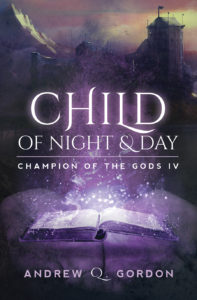
    I can, however, share a few things about what to expect in 2017. Two major things are Child of Night and Day – Book 4 of Champion of the Gods will be released on April 11. (Here’s a look at the cover). The other is Book 5 will be finished and submitted to the publisher.  After that, my writing world is wide open.

    At the tail end of 2016, I outsourced some of my marketing work so I can write more. That’s a big deal, but write more began in 2016. I’d also like engage more with readers, but since that’s part of the marketing plan that I began last year, that’s not new for 2017 either.

    One thing I should do, but haven’t made  plans for yet (or even tried much), is take another writing course. Despite recognizing I could always improve, I’ve not made that effort in a few years. There, I have one; in 2017 I’ll take a new writing course…. If I can find one that fits my schedule…. And looks interesting…. Oh and it needs to be affordable. But I’m really going to try to do it. Hmm. Try isn’t the same as a resolution, is it?

    Maybe the best course is to let things progress and see what happens. What is clear now, might cloud up as the year goes on. And what is murky today, might be less so when the days are longer. Things may change and I’ll want to shift gears. Or double down. Or scrape something entirely. At that point I’ll be ready to make my resolutions.

    Good thing there are so many different ways to mark time.