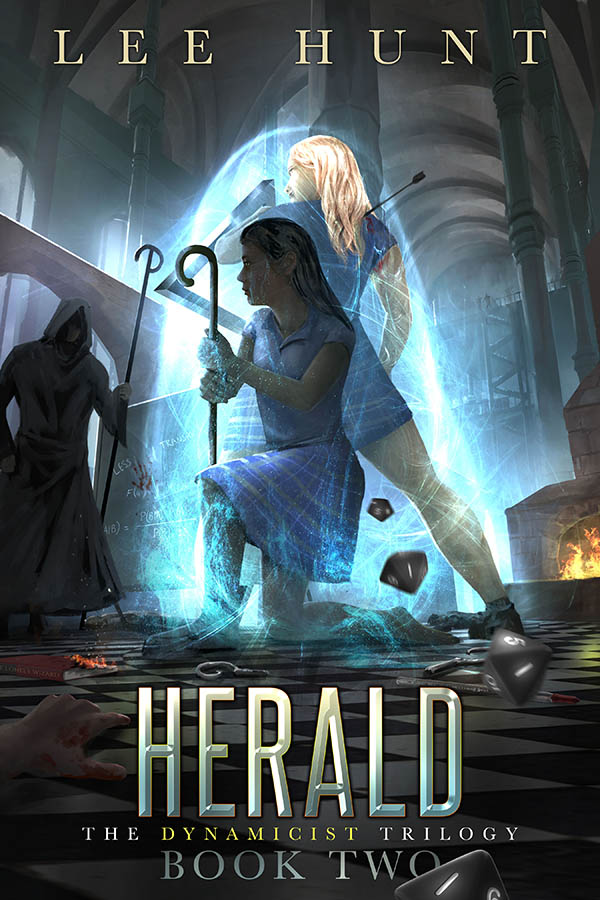
Lee Hunt has a new fantasy audiobook out in his Dynamicist Trilogy: Herald. And there’s a Giveaway!
Robert thought becoming a dynamicist would enable him to change the world, starting with saving all his friends from being slaughtered. He was wrong.
Acts of genuine creativity used to bring mortal punishment. But now, wizardry is dead and Robert, Koria and Eloise live in a world where change and invention is possible.
Robert hopes that mathematically-framed dynamics will enable him to change the new world. But he keeps having prophetic dreams where his friends are all murdered by a mysterious cloaked man, and the grain protestors are more menacing than ever. They declare dynamics is dangerous and that the changes must stop. They are right about one thing: dynamics is dangerous, especially for someone so hopeful, angry and impetuous as Robert.
Soon Robert’s horrific nightmares come true and a cloaked man appears on campus, stalking and murdering students –his friends are next.
Desperate to change the future, Robert recklessly pushes the bounds of both dynamics and reason. Every crushing failure dampens Robert’s hope for the future and pushes him a step closer to the powerful, nihilistic, and merciless Lonely Wizard.
Series Blurb:
Would it kill you to create something genuinely new? In Robert’s world, it used to. Supernatural vengeance for invention is now a thing of the past.
Young, optimistic, quick of mind and quick to act, Robert thinks being invited to the New School is an invitation to change the world. But change is difficult when there is no history of innovation.
He is initially successful in his studies, but nothing is as simple as he naively imagines. His classmates confuse and frustrate him. One is a drunk, while another two constantly stalk him. Is it for love or something more sinister?
Robert’s optimism is further tested by protestors who circle the campus, decrying the newly invented breed of grain. They claim it is poison and that the New School should be punished by Nimrheal, the god who formerly murdered inventors. Robert suspects foreign business influences are behind the protests, but he quickly finds that investigating their cause is dangerous.
Robert’s most difficult challenges are his unresolved childhood issues. His mother died while he was a child. Robert’s formative helplessness and inability to remember her face projects into a powerful and blinding protectiveness towards all women. When a campus assault pushes Robert over the edge, his hopes of even staying at the New School are jeopardized. He cannot aspire to change the world if he does not even know himself.
At the same time as Robert struggles on campus, a powerful, ruthless and emotionally closed man known only as the Lonely Wizard journeys across an empty wilderness to return home. As Robert and the Lonely Wizard move closer together, Robert finds that instead of entering a golden era of invention, he may instead be on the brink of a cold war and an endless, unchanging dark age.
Davyn’s whistle tore the air again, but someone lunged at him and the big man stumbled and swallowed the thing. He staggered back, choking.
Whesplurgh!
“He is liar!” roared one of the bald, stocky men in his thick accent, pointing at Endicott. “We’ll beat the truth out of him!” He stepped forward and began drawing his sword.
Cyara rallied from her shock. “No one beats anyone here!”
His bald, stocky companion pushed Cyara roughly, and she stumbled backwards into the crowd. This was too much for Endicott. His heart leapt, and without thinking, he grabbed the heavy iron bacon pan and swung it, bacon-outwards, at the thug who had struck Cyara.
Gong! Glahhr!
Bacon, grease, and pan connected ferociously, and as a unit, with the man’s rotund head, knocking him heels over cartwheeling head to the ground. His sword clattered to the floor. The other bald man came on, lunging with his sword. Endicott turned the blade aside with the pan and tried to step back, but he stumbled over Purple Hat, who was arguing with someone else behind him. The swordsman saw his opportunity and rushed forward, sword raised for an overhead strike, but stopped short with a puzzled look on his fat face. Something had caught hold of his foot. It was Cyara. She had him by the ankle in a surprisingly strong grip.
Gong! Glahhr!
Endicott struck him in the face with the pan before the swordsman could kick Cyara loose. As his attacker fell back, Endicott looked for Cyara, but she was hidden by a shift in the crowd. Then he saw Davyn. His big friend was surrounded by a group of people who were trying to help him cough out the whistle. Endicott almost laughed and was about to return to the two bald protestors when he was savagely struck on the temple by a blow he did not see.
Author Bio
After having the Last Rights read to him at the age of twenty-five, Lee Hunt came to appreciate the power of catharsis. He was born on a farm with only one working lung but has gone on to become an Ironman triathlete, sport rock climber, professional geophysicist, and writer.
As a scientist, Lee has published close to fifty papers, articles, or expanded abstracts, has been awarded numerous technical awards, and was even sent on a national speaking tour. He enjoys discussing the amorality of science and is useful at parties in explaining the physics of whether fracture stimulation might be a risk to the fuzzy, cuddly things of nature. After 28 years trying to understand the earth as a geophysicist, Lee turned to writing fiction. He now spends time hiking, cycling, floundering in a lake, clinging desperately to a wall, or at his desk trying to write an entertaining story.
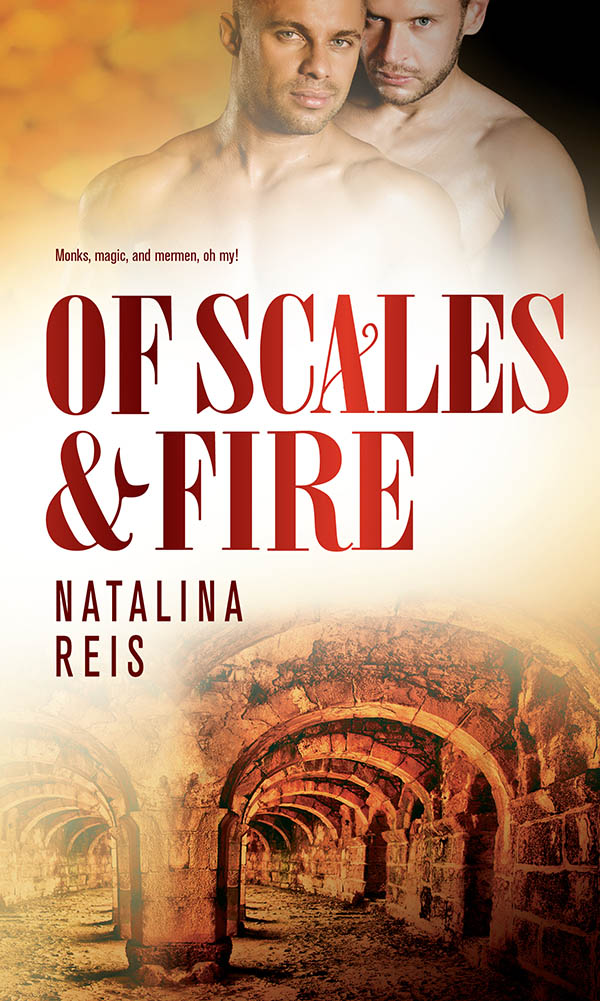
Please join me in welcoming Natalina Reis to the Land of Make Believe! She has stopped by to share her thoughts on writing outcasts and celebrate the release of her new MM gay/bi paranormal/urban fantasy romance, Of Magic & Scales book two: Of Scales and Fire. And there’s a giveaway!
Welcome, Natalina!
Natalina Reis on Writing Outcasts
I’m often accused of writing “weak” characters, immature and insecure. I admit, I often write characters riddled with doubts about themselves and how others feel about them. I also know my characters usually come off as being a bit childish either because of my penchant to use a lot of humor or because, well, they display a lot of insecurities. But I never write weak characters.
People normally equate being assertive and secure with being strong. To me what makes a person strong is the ability to face those things that make you uncomfortable or to soldier on when you’re afraid or anxious. Not much different from the definition of a hero. A hero is not someone who is not afraid but someone who acts despite being terrified.
Aiden, in the Of Magic & Scales series, is only sure about one thing: his sexual prowess. Other than that he second guesses himself at every turn including doubting that anyone could ever really love him. Does that make him weak or immature (well, he is immature by his own admission)? I beg to differ. Despite all his doubts, his fears, Aiden is always willing to risk it all for those he loves and willing to change and accept things he couldn’t—or wouldn’t—before. To me that’s the real challenge, to be able to surpass your fears and doubts and come up on top in the end.
My writer’s tagline reads “Writing romance for the misfits, the outcasts, and the lovers unafraid to go against the grain” and that’s exactly what you will find in all my books, it doesn’t matter whether it’s a FM romantic comedy, a romantic fantasy, a dystopian romance, or a MM paranormal. In each of my stories there is someone who struggles against his/her own doubts and limitations but does not let that stop him/her from achieving his/her goals.
Of Scales & Fire
The cast of supporting characters from Natalina Reis’s “Of Magic and Scales” are back and stronger than ever, and so are the pop culture references and silly jokes Aiden likes so much. As Aiden and his new family are joined by an unexpected antagonist that may yet prove to be their undoing, will their (un)domesticated new life as a couple be turned upside down?
Aiden Mercer’s life has changed dramatically since his days of being a man-whore, where he spent most of the time either running his coffee shop in sunny Portugal or man-watching at the beach. He now has Naël, a cranky merman to love and to hold, and his sister, Vee, and friends to care for. Life is good.
But life never seems to stop surprising the American ex-detective. A mysterious order of monks, a mermen poacher, shocking revelations about his parentage—and whoever is hunting him down—turn Aiden and Naël’s summer into one to remember. Or maybe one they’d rather forget.
It had become a running joke with us—the fact that I had no clue who or what I was. It was painfully obvious I was a magical of some kind, but no one seemed to be able to identify which one. I had lived my whole adult life thinking I was just a Joe Schmo, only to find out that was far from the truth. I was still pretty ambivalent about it. It was nice to have powers other humans could only dream of, but on the other hand, it also meant I was forever linked to a group of creatures I had fought so hard to stay clear of.
I pushed him away, pretending to be mad at him. “Well, I am very poorly acquainted with my own powers, and until I learn how to better control them, I’m not much help to anyone.” I took another quick peek at the couple now walking out the door.
Fouchard slapped me with the kitchen towel. “Those powers were what saved my sister two months ago.” It was true; I had helped rescue his sister from the hands of a serial killer bent on getting rid of all magicals who didn’t fit the traditional mold. My boyfriend took a couple steps until his lips hovered over mine, his heady scent invading all my senses. He was the one who held all the magic. “Stop being so down on yourself and own it. You do with everything else, why not with this too? It’s part of who you are.” True, except I really didn’t know who I was. Fuck, I didn’t even know my own birthday. “Besides, you have magic in those fingers of yours,” he whispered, a wicked smile spreading on his lips. “You’re a true sorcerer with that mouth.” He brushed a thumb along my lower lip. Then he looked down at my crotch and licked his lips. “And other magical parts.” He let it hang as he lifted his eyes to mine.
Author Bio
Natalina wrote her first romance at the age of 13 in collaboration with her best friend. Since then she has ventured into other genres, but romance is first and foremost in almost everything she writes. She’s the author of We Will Always Have the Closet, Desert Jewel, Loved You Always, and Lavender Fields.
After earning a degree in tourism and foreign languages, she worked as a tourist guide in her native Portugal for a short time before moving to the United States. She lived in three continents and a few islands, and her knack for languages and linguistics led her to a master’s degree in education. She lives in Virginia where she’s taught English as a Second Language to elementary school children for more years than she cares to admit.
Natalina doesn’t believe you can have too many books or too much coffee. Art and dance make her happy and she is pretty sure she could survive on lobster and bananas alone. When she is not writing or stressing over lesson plans, she shares her life with her husband and two adult sons.
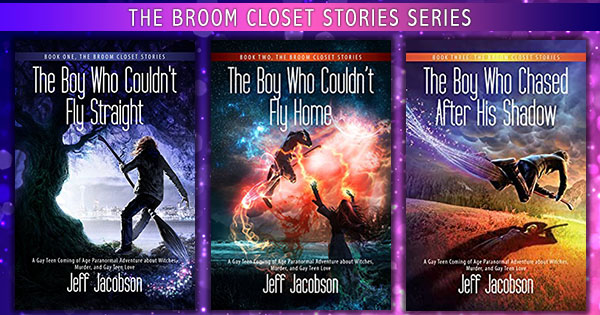
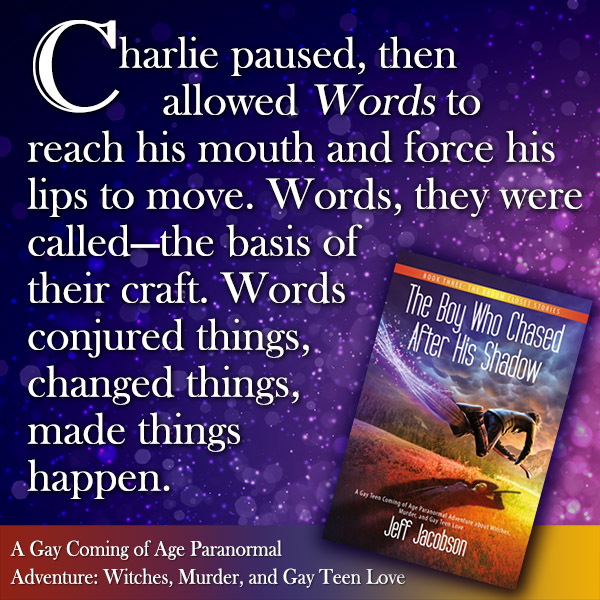
Jeff Jacobson has a new queer YA urban fantasy romance out, Broom Closet Stories book 3: “The Boy Who Chased After His Shadow.” And there’s a giveaway!
What If an Evil Witch Was Controlling Your Thoughts Without You Knowing?
Soon after being whisked away to Seattle to live with an aunt and uncle he barely knew, Charlie Creevey learned that he hailed from a family of witches. After settling into this unfamiliar life, his feelings toward his new friend Diego Ramirez began to grow into something more serious. And if that wasn’t enough, he failed to stop the nefarious witch Grace and her cohort from using the dreaded deathcraft and killing his mentor Malcolm.
In Book 3 of this riveting series, Charlie discovers that Grace has gone into hiding and is acting behind the scenes. Able to influence minds in ways that were previously unheard of in the witching world, Grace compels Charlie to unwittingly do things like taking on the bullies at Puget Academy and lying to his family. The more Charlie believes he is acting of his own accord, the more Grace secretly rebuilds her strength and plots her comeback.
Will Charlie ever be able to overcome Grace and her coven? Or is Charlie destined to live life as a gay teen witch, shrouded by the evil veil of the deathcraft? And can he ever share his secret with Diego—or will he have to keep his identity as a witch hidden in the broom closet forever? Find out in The Boy Who Chased After His Shadow.
High school life as a gay teenage witch is never easy. Ask Charlie Creevey, the boy who’s busy developing his witchcraft abilities while navigating romance with Diego Ramirez. Forget about focusing on schoolwork, too, thanks to an evil witch and her ilk who will stop at nothing to destroy everyone around them, including Charlie and his family, for power. All he wants is some normalcy… but will Charlie ever be able to share who he really is? Or must everything remain a secret?
From paranormal adventures and a whirlwind romance, to battling evil witches and a gripping conclusion, enjoy all the thrills and excitement, in the supernatural world of the Broom Closet Stories.
Giveaway
Jeff is giving away a $25 Amazon gift card to one lucky winner:
“JACK-O’-LANTERNS,” DIEGO WAS SAYING, the carving knife in his hand glinting in the dining room’s candlelight, “started as tiny squash containers to hold the coals from the fires built by the ancient Druids. Each household carried a coal home and used it to start a fire in their hearth. They believed this would bring them luck and blessings for the coming year.”
Beverly, Randall, Charlie, and Diego, along with Rita and Jeremy Lostich, sat together in the dining room at the house on Washington Street. The dining table, covered in layers of newspaper, was laden with mugs of hot apple cider for the boys and pumpkin IPA for the adults, plates of cake donuts, two bowls of roasted pumpkin seeds, regular and tamari-flavored, plates of Spanish tapas stuck with wooden skewers, and an array of pumpkins. The smells of cinnamon, apple, and clove, mixed with the raw scent of pumpkin flesh, hung above the carvers. In the background, vintage Halloween music from the thirties and forties by Cab Calloway, Rosemary Clooney, and the Bones Boys added to the holiday atmosphere. True to form, Amos wandered back and forth between the promise of warmth from the roaring fire in the fireplace and the possibility of a dropped piece of food near the table.
Charlie had scooped out the innards of his soccer-ball-sized pumpkin, wondering exactly what kind of face to carve. He watched Diego slice into the top of his mostly untouched pumpkin. He seemed more interested in educating the adults on the origins of Halloween than actually making progress on his jack-o’-lantern.
“I think it’s a cool tradition. I’d like to bring an ember from your fireplace home in my pumpkin tonight—if that’s okay with you,” Diego said, looking at Beverly and Randall. “It’s a thing we witches like to do.”
Jeremy, who at that moment had just taken a large swallow of pumpkin IPA, began choking on the liquid.
Rita set her knife down and patted her husband on the back as he coughed. “There, there, dear, you okay now?” she asked. Diego missed the smirks shared between the adults.
“Went (cough cough) down (cough cough) the wrong (cough) pipe (cough cough),” Jeremy managed to say.
With a final swat of her hand to his back, which nearly sent her husband sprawling forward on the table, Rita picked up the small craft knife again and made a tiny cut on the face of her pumpkin.
“Well, however the tradition started, I think this is a lovely way to spend an October evening together.”
The group voiced their agreement and continued to chat, carve and laugh together.
Charlie was about to ask Beverly if she thought he should carve a grinning mouth or something more sinister, when out of nowhere, his vision began to swim, followed by a blackening down his eyes and face, as if someone had poured a bucket of shadows atop his head.
The warm, festive dining room in which he sat, the place where he had eaten many meals at the house on Washington Street, disappeared. He felt a soft carpet beneath his feet. He was looking down at a glass coffee table, under which lay a teenage boy with short, dark hair. Blood coated his arms and cheeks, and his eyes were both tired and horrified. Next to Charlie stood Thomas, Tony, and Claudia, droplets of blood on their clothing.
Charlie burned with a hint of the same kind of bloodlust he felt when gripped by the deathcraft.
He wanted more. “No, please,” the boy begged.
“Don’t you mean ‘Yes please’?” asked Tony as he leaned down over the table. Charlie watched as blood dripped down Tony’s bare forearm.
“Wait!” he shouted in Grace’s voice.
It took him one horrific second to realize that he was inside of Grace, looking down at the boy through her eyes, before his head filled with memories that were neither Grace’s nor his own: walking hunched against the windy cold in downtown Seattle; seeing a dumpster fire; sitting in the backseat of a red Ferrari as Tony and Thomas drove up and over a hill; the two men and two glamorous and beautiful women surrounding him; sharp pain as a knife made gashes in his chest, his arms, his neck.
The personality and identity of the boy filled him: Tristan Cloud, a young teen from Olympia, who had run away from home because his father couldn’t accept that he was gay, hustling on the streets of Capitol Hill, dread in his gut turning to terror and helplessness as he realized what a bad decision he had made to get into the car that night. Then, a confusing mess of days that involved cutting, screams, cajoling, cruel laughter, and an overwhelming desire to fall asleep and be done with life.
It took Charlie a moment to figure out that the Fab Four were taking sips of Tristan’s life force, which gave them full access to the boy’s thoughts, memories and emotions. And because Charlie was linked to Grace via the deathcraft, he’d been yanked inside her once again.
“No!” Charlie shouted, standing up from the dining room chair on which he sat at the house on Washington Street.
Four adults and one teen looked at him, hands holding carving knives and drinks frozen in midair.
“Charlie?” asked Diego, confused. The adults were already looking at each other, already trying to communicate ideas and plans without Charlie’s boyfriend noticing.
He knew he had to say something. “No! I forgot the, uh …”
Desperate, he looked over the table for some excuse. Gutted pumpkins with carved faces stared at him, their insides in piles on the table, making his stomach turn. Candles, Halloween decorations, food … “The special decorations! I forgot the special, secret decorations!” he cried, looking hard at his aunt as he spoke. “Be right back!”
Author Bio
Jeff Jacobson was born and raised in Seattle and graduated in 1991 from the University of Puget Sound in Tacoma, Wash., with a degree in Asian studies and a minor in Chinese language (Mandarin). He works both as a coach and a trainer of coaches, and is passionate about how evolved leadership can help transform organizations, their clients, and even the world.
The Broom Closet Series emerged from a challenge/dare after Jeff Jacobson criticized other books for how they depicted witches (“Windswept hair… spells, always in Latin…” no, no, no). The friend he made these comments to called him out on his critique, noting that the authors wrote their books, not Jacobson’s. Could he write his own witchy books? In 2008, Jacobson decided to find out.
Already top sellers on Amazon, The Boy Who Couldn’t Fly Straight and The Boy Who Couldn’t Fly Home chart teenager Charlie Creevey’s double coming out – as a young gay man, and as a witch. He lands in the hamlet of West Seattle and becomes part of the local coven, which he needs in order to fight off Grace, a murderous villain who’s killing teens to fuel her power and control. Jacobson picks up the thread yet again in The Boy Who Chased After His Shadow as Charlie’s feelings for classmate Diego Ramirez deepen, and Grace’s pitiless murders terrify and threaten the community.
Please welcome first time guests, Beryll and Osiris Brackhaus.
They have a new sci fi/space opera book out, Virasana Empire: Dr. Laurent Book 1: “The PV-3 Mutagen.” And there’s a giveaway!
Blurb:
As a history scholar and courier for the secretive Circle of Thales, Rene Laurent is a man of many talents – none of them lending themselves much to a life of adventure.
But when a chance meeting with a young, idealistic Belligra priest drags him into a wild quest to keep a dangerous mutagen off the streets of Floor, his curiosity gets the better of him. Between monsters both human and man-made, he realises that maybe fieldwork is more of his game than he had ever thought possible…
Written by Rainbow-Award-winning authors Beryll and Osiris Brackhaus, ‘The PV-3 Mutagen’ is a colourful non-romance sci-fi adventure set in the wildly diverse ‘Virasana Empire’, and the first novel of the ‘Doctor Laurent’ series.
Warnings: Not a romance. Harsh setting, but hopeful.
There were five of them. At least, five that Rene was aware of.
He had spotted the three following him when he took the escalator to the bottom floor of the mall. He had originally planned to take the tube train to Cherry Hills, but instead he turned into the access tunnel that led up to the street, trying to shake them off. Judging by the two who were now cutting him off just ahead, that had been a bad idea. The tunnel they were in was sufficiently removed from the cheap glitz of the mall to be only dimly lit, and the only other person here was a woman pushing a shopping cart, purposefully hurrying away from the developing confrontation.
A quick look around showed Rene there weren’t any convenient emergency doors he could slip through, either. He was in trouble.
At least, they didn’t seem to be professional mercenaries, just some gangers, though they moved with too much purpose to be out simply to mug him. And no ganger deserving of their colours would mug a scruffy street rat like him, anyway. To them, he had to look like he didn’t have anything worth the trouble, as much a carefully crafted facade as laziness – he liked his comfortable rags a lot, thank you very much. So what did these particular thugs want from him?
And more importantly, how to get rid of them?
He was well aware that he didn’t stand a chance against them in a fight. Combat skills were at the bottom of the list of things he was interested in. Also, the mall was too cheap to have any sort of camera surveillance. It didn’t even have security guards though Rene doubted any would have come running if they had existed. He wasn’t a valued customer, and as long as the gangers didn’t make too much of a mess, no one would care.
The best course of action seemed to be to play the helpless victim and let them rough him up a little. It wasn’t like they would manage to inflict any lasting damage, anyway.
He had come to that conclusion when one of the thugs, whom Rene mentally labelled their ‘leader’, shoved him against the wall.
Rene turned to face them, clutching the stack of folders he was carrying to his chest protectively, trying to present a credible picture of being scared. The other thugs had formed a semicircle around him and their boss. Judging by the nasty grins of his ambushers, it wasn’t very hard to fool them.
“Gimme that,” the leader snarled and grabbed the folders.
They held the weekly update on the topside situation in this sector of Floor. Nothing too important, and certainly not irreplaceable. Rene had picked them up a few minutes ago at the office of the info broker the Circle of Thales was currently employing. He congratulated himself on not yet having picked up the datacrystal with the off-planet reports from the Beetle Shack under Cherry Hills. He had planned to do that on the way back down before having a lunch of lava beetle while he was there.
He let go of the folders with a strangled whine and cowered.
“Hank’s Beehive is off-limits,” the leader sneered, “didn’t you get the memo? He is about to shut down.”
So that was what this was all about. The info broker Rene had just visited had been in a turf war with another info broker two malls down the street for a while, but apparently, things were heating up. Not something he cared to get involved in even though Hank was a decent guy. Well, make that a decent guy for Floor.
“Can’t have that idiot handing out charity, can we? Not the Floorian thing to do, eh?” The leader clearly wasn’t expecting an answer as he rammed his fist into Rene’s stomach.
The punch drove the air out of his lungs and hurt like a bitch. Or rather, it hurt for the few seconds it took his body to repair the damage. Rene crumpled to the ground in a heap. If he looked sufficiently hurt, they would hopefully leave him alone quickly. And not search him. If they tried to take his phone, he would have to do something, though he admittedly had no idea what.
“You understand me, little shit? You stay away from now on!”
“Hey! Stop that!”
A voice ringing out loud and clear in the narrow tunnel rudely interrupted the leader’s little speech.
Rene glanced up through his long hair hanging in his face and did a double-take. The tunnel leading back towards the mall was almost filled out by a tall figure in heavy, plate armour, wielding both a broadsword and a fucking tower shield so large he could completely hide behind it. The symbol on his surcoat and shield was unmistakable – Temple Belligra, the Fist of the Church. It was about the last faction Rene wanted to have get involved in this minor scuffle.
Priests were infamous for poking their noses where they didn’t belong. Luckily, they were rare on Floor. Yes, they had a few Verata, but they mostly remained inside their Fort Phosphoros Monastery. The occasional Jansahar only paid attention to the local flock who worshipped at the small shrines they kept all over the planet. Both groups were easy enough to evade for someone who didn’t need supernaturally talented people scanning them and finding out they were an unregistered psion.
But seriously, a Belligra? There were no faithful in need of protection here on Floor, mostly because there were no faithful here. Floor prided itself with being the most secular planet of the empire, and it was a reputation hard-won.
But apparently, this particular Belligra was set on rescuing him.
Excerpt 2 – Confrontation
Riccardo was prowling towards them, now, with his sword drawn, cutting quite the figure in his bulky armour. He looked like he might be able to hack the probably armoured limousines to pieces. Rene followed him at a safe distance.
The driver of the front limousine was standing next to the access console of the garage’s roller gate. He must have noticed Riccardo already, because he was staring straight at him, like a rabbit frozen in an oncoming car’s headlights.
“What are you waiting for?” An angry voice came from the open backseat window of his limousine. “Open the fucking gate and get us out of here!”
“You will not touch that console,” Riccardo commanded, his voice booming in the harsh acoustics of the garage. “Back away from the glider, get on your knees, and fold your hands behind your head.”
Riccardo was halfway across the garage from the gliders, so the driver would have had time to press the button to open the gate and hide in his armoured vehicle. Instead, he hectically looked back and forth between the approaching Belligra and the open window behind which his boss must be. He took a tentative step away from the console.
“Don’t you dare!” the voice from inside the limousine yelled, now even angrier. “I won’t just fire you, I’ll make sure you never find a job on all of Floor again, you ungrateful son of a bitch!”
Rene was beginning to see why everyone they had met so far hadn’t shown a shred of loyalty towards Mr Gutierrez, assuming that was him. The driver came to the same decision as his expression shifted from insecurity to grim resolve. He firmly stepped away from the console and the glider, got on his knees demonstratively facing away from both and folded his hands behind his head.
“Claude! Claude, you do it!” the man in the limousine screamed, “You drive the limousine!”
“Mr Gutierrez, I am not licensed to…” another shaky voice, also inside the limousine, answered.
“I don’t care! We have to…”
He was cut short as Riccardo arrived at the limousine, reached through the rear window and – judging from the choked yell – grabbed the man inside by the throat and shook him none too gently. “You’re not going anywhere!” Riccardo snarled, “You will face your crimes like an adult. You have sinned and God has sent me to exact punishment!”
Not exactly how Rene would have phrased it, but certainly impressive. If this was the man in charge, he deserved everything Riccardo was going to do to him.
The backseat window of the second limousine whirred down and a haggard woman in her fifties looked out. She was wearing her blonde bleached hair messily piled on top of her head and an expression of haunted horror on her face. “I confess!” she proclaimed loudly, “I confess everything. We have done wrong! All of us! This whole project is…”
“Shut up, Gabriella!” another female voice from inside her limousine interrupted her, “Shut the fuck up, you’re burying all of us!”
“You don’t understand!” Gabriella turned back to her colleague, “Don’t you see it? God has sent…”
“God has better things to do than…”
“Silence!” Riccardo’s thunderous voice echoed in the garage, followed by exactly that. “Everyone step out of the gliders,” Riccardo ordered at a much lower volume. “Do not resist or I swear by God, I will cut in half anyone who does.”
Gabriella yanked open the door of her glider and scrambled out so quickly, she stumbled and lost her footing, ending up on her knees. She quickly decided that it was a great position to be in and copied the driver of the first limousine, folding her hands behind her head. She was wearing a long, green lab coat. The technician by the elevator had mentioned Mr Gutierrez being in the company of scientists, so Rene guessed she was one of those. Her name tag identified her as Dr Gabriella Sanchez.
She was followed more slowly by another woman, this one in her early thirties, with perfectly coiffed, red locks, wearing too much makeup on her admittedly pretty face, and the same green lab coat. Her name tag said Dr Jada Shekyim. She looked down at Gabriella disdainfully and remained standing, studying Riccardo with an aloof expression. The limousine’s driver exited as well and calmly joined his colleague on the floor. The last one to emerge was another scientist in a lab coat, a man with obvious cybernetic enhancements to his left eye, evidenced by metal elegantly merged to skin around it and several dataports on the same side of his shaved skull. His name was Dr Silas Bisgaard. He looked mostly bored of the whole episode.
The passengers of the first limousine weren’t as cooperative. Rene had no clear view of what was going on inside, but from the sound of it there was a scuffle going on, with Riccardo holding on to – probably – Mr Gutierrez.
Then the other passenger door opened and a young man spilled out, scrambling away from the car hurriedly. Early twenties, cheap suit in last season’s style, a mop of tousled, brown hair, glasses clutched in one hand. Claude, Rene guessed, and by the look of him, Mr Gutierrez’s personal assistant. That finally stopped the struggling inside the limousine.
“Let go of me, you brute,” Mr Gutierrez grunted.
“Are you ready to obey?” Riccardo asked.
“I comply under duress.”
Why he thought that would mean anything to Riccardo, Rene had no idea. But it certainly sounded like company speak. Riccardo withdrew his hand and the door opened. Mr Gutierrez stepped out in as dignified a manner as he could under the circumstances and made a show of straightening his tailored designer suit. Around forty, carefully groomed from his slick black hair, over his thin moustache, down to his shiny, black shoes, probably made from real leather. Everything about him screamed upper management position. Not rich or powerful enough to get away with wearing whatever eccentric shit he pleased, but with enough disposable income to show off.
He glared first at Riccardo, then at the drivers, the scientists, Rene, and finally at Claude, who was coming around the glider to where Riccardo could see him.
Claude shrank from the baleful glare of his boss, but he was the only one to react.
“Mr Gutierrez,” Riccardo addressed him coldly, “you and your company have committed severe sins against the order God has given our universe by messing with his designs in ways that endanger innocents and pose incalculable risk to humanity as a whole.”
Mr Gutierrez scoffed at the accusation, but Riccardo’s phrasing gave Rene an idea. He pulled out his phone for some quick research.
“You have broken into our building and are threatening me and my employees with violence,” Gutierrez wasn’t backing down. At least, he was doing it from a reasonably safe distance and not getting right into Riccardo’s face. “I’m going to sue you and your Church! You will pay for this…”
“A Belligra can not be charged with forced entry, property damage, assault or manslaughter crimes when on a mission for the Temple,” Riccardo cited in turn. “I have every right to be here.”
“What? A thug like you has no right to lay a finger on me!”
Riccardo leaned in close, threatening Gutierrez with his sheer physical presence. “Go ahead. Give me a reason,” he quoted Lady Rage’s catch phrase when she was dealing with stubborn officials.
Gutierrez had obviously seen a few Lady Rage movies too, judging from the way he instantly recoiled.
“I believe he is right, Mr Gutierrez. Temple Belligra has special rights,” Claude supplied helpfully.
“That’s ludicrous!”
“If you think that is ludicrous you will like this even less,” Rene chimed in, having finally found what he had been looking for. “Imperial Decree #354.223 states that the Church, in their sacred mission, is exempt from several prosecutions, citing that, among others, Temple Belligra cannot be charged with anything concerning the actus reus of manslaughter, assault, property damage, forced entry and trespassing. Also, and I think this might be of more relevance to the matter at hand, as stated in the bannbulle ‘De sacris separatio Anima et Materia‘, the Church has banned all experimentation touching in any way the supernatural abilities of any creature, except for cases explicitly waived after church examination.“
Everyone was staring at Rene as if he had suddenly sprouted a second head, like he was now the most dangerous thing in the room, not Riccardo.
“That’s from the Fort Phosphoros netsite, by the way,” Rene added gleeful.
“Well, shit, we’re fucked,” Dr Bilsgaard commented dryly.
“Why didn’t the legal department check this beforehand?” Dr Shekyim turned on Mr Gutierrez. “You’re telling me I have invested months in this project to have it yanked from under my ass by some robed freaks?”
“I told you what we were doing was wrong,” Dr Sanchez whimpered from the floor, “That we shouldn’t mess with…”
“You scared, little bitch! What I have accomplished is unparalleled. Once we moved to human applications we could have…”
“Silence!” Riccardo bellowed again.
Author Bio
We are Beryll and Osiris Brackhaus, a couple currently living our happily ever after in the very heart of Germany, under the stern but loving surveillance of our cat.
Both of us are voracious but picky readers, we love telling stories and drinking tea, good food and the occasional violent movie. Together, we write novels of adventure and romance, hoping to share a little of our happiness with our readers.
An artist by heart, Beryll was writing stories even before she knew what letters were. As easily inspired as she is frustrated, her own work is never good enough (in her eyes). A perfectionist in the best and worst sense of the word at the same time and the driving creative force of our duo.
An entertainer and craftsman in his approach to writing, Osiris is the down-to-earth, practical part of our duo. Broadly interested in almost every subject and skill, with a sunny mood and caring personality, he strives to bring the human nature into focus of each of his stories.
Colin D. Vaughn has stopped by the Land of Make Believe for a quick chat plus a giveaway to celebrate his new release, Expression: Telepaths Rising. Welcome, Colin!
Exclusive Interview
AQG: Would you visit the future or the past?
CDV: As a writer of science fiction I know I’m probably supposed to pick the future, but I think I would visit the past. Specifically, I’d probably go to the Roman Empire during the Pax Romana. I’ve always had a strong interest in the time period and even studied Classics in high school.
This interest is reflected in my book by the questions that try to wrestle with. What does it mean to be a citizen? What’s good government? What’s it like to live in a world where you feel like anything is possible?
Also, classism and elitism are important themes to my story. What social stratum would a telepathic segment of the population occupy? While it’s easy to imagine them as an elite, and they are to a significant extent in the first book, I also wanted to show an Earth where that’s not universal, accepted or enduring. Even having a significant advantage over others is not necessarily enough to keep one from being relegated to an oppressed class.
Tying that back to history and the Roman Empire, it’s informed my writing with respect to issues of class. It’s allowed me to complicate things in a way that I find more interesting.
AQG: Complicate things how?
CDV: Well, I’d read recently that archaeological finds has changed the way some historians think of slavery and class in the Roman Empire. There seems to be evidence that movement was a lot more fluid and complex than previously believed. A person of that era might reasonably aspire to a full citizenship no matter how “low” their origins. They might have dreamed (however realistically) of a citizenship rooted not in race or pedigree but in the adoption of a way of life. Or, in a darker way, what would society be like in a place where one slave could own another slave?
For me, as a Black American, that’s a far more interesting view of society and oppression than the American experience which was far more rigid. In other words, for my story, if telepaths are oppressed somewhere, how might that look if it wasn’t a formal, legalized system – less America or South Africa and more Roman. What if it was a system based on the vagaries of individual treatment and local mores? And how might individuals act in a world where anything goes and anything is possible, for good or ill?
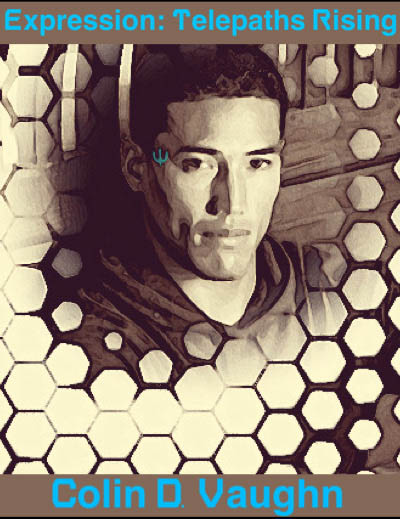
Colin D. Vaughn has a new queer multi-racial sci fi book out: “Expression: Telepaths Rising.” And there’s a giveaway!
It’s the year 2113. Telepaths are real. They’re exalted. Feared. Hunters. Hunted. Kingmakers and slaves. With his expression, Ken is catapulted into the ranks of a tiny elite. With immense telepathic potential, he will have to learn how to use his powers and whom to trust. And quickly. Because there are enemies, both within and without, and they’re not going to wait.
Tarrington placed his datapad on the table. “This begins the psychic assessment of Kenneth Jared Kawashima. Nigel Tarrington, Authorized Facilitator of the Ministry of Citizen Services and Mauricio Vargas, an Authorized MCS Liaison from the Ministry of Psychic Affairs, presiding. Also in attendance are the subject’s father, Takahiro Kawashima; mother, Claire Alma Reed; and sister of minor age, Stephanie Fusako Kawashima.”
Tarrington turned to me: “Kenneth, pursuant to the Telepath Registration Act, as a suspected telepath you are required to undergo psychic assessment. You may not decline, delay or obstruct this hearing in any way. You may, however, have the presence of counsel at this proceeding. If you do not have one available to attend within 24 hours, one will be provided to you by the Ministry. Please touch the datapad and state whether you request or waive counsel.”
All of this was rather pro forma – I was surrounded by my family and it wasn’t as if a lawyer could stop or save me from this process. Not that I wanted it to stop. I touched the pad. “I waive counsel.”
The datapad chirped: “Identity confirmed. Waiver of counsel acknowledged.”
Tarrington turned to my parents. “Please touch the datapad to confirm that you have no objection to this proceeding, its recordation, or your son’s waiver of counsel.”
My parents touched the pad and it chirped: “Identities confirmed. Acknowledgements confirmed.”
Tarrington smiled, “Well, now that all that fussy business is complete. I will turn things over to Mr. Vargas.”
Vargas smiled at me, and then, clear as a bell in my head, I heard him sing a jaunty tune: I am the very model of a modern major general. I am the very model of a modern major general.
I laughed and asked him, “So you’re a general, eh?”
He smiled: No, more like a lowly foot soldier, little brother. Ask me a question. In your head – look into my eyes and say the words of your question one at a time. Remember, don’t speak.
I looked him straight in the eyes and thought: Where. Are. You. From?
Honduras. Suddenly I could see a wide stretch of forest, leading to deeply forested mountains, their tops veiled in low-lying clouds. Though I knew I was still crouched on the floor of our living room, I cool also feel moist spongy earth under my feet, a cool breeze across my cheek. This is my home. Well, actually, my hometown is the metropolis of Gracias a Dios, but the rainforests on the outskirts are what I think of as “home.”
For a moment, I almost felt like it was my home, too. I, who had only ever left Tennessee for our family’s annual trip to the Japan Territory, almost ached to return and hike those forests. Gracias a Dios. Thank you.
It wasn’t until Vargas smiled and said aloud: “My pleasure” that I realized that I had spoken to him mind-to-mind again, but in a natural, almost instinctual, way.
Was this what it meant to be a telepath? This incredible sharing, this intimacy? I felt as if Vargas – no, Mauricio– was some long-lost friend. Could he sense the same about me? I was just about to ask him for more when Tarrington clapped his hands once and said, “I take it that it was a success? He’s a true expressive?” I came to and looked around. My family was just staring at me. At me and Mauricio.
Mauricio nodded, then reached and touched the datapad: “Confirmed that subject’s telepathic gene has expressed, as verified through the receipt and transmission of audio, visual and tactile stimuli between subject and myself.”
Tarrington said: “Excellent! Now, Ken… I may call you ‘Ken,’ yes? . . . You understand that you will be more fully and properly assessed by the Psych Ministry at a later point?” I nodded. He then continued, “However, for myMinistry’s purposes an initial, somewhat rough assessment is necessary. Mr. Vargas will perform this. I am sorry for any discomfort.”
Mauricio then said aloud: “Ken, I will now force myself onto you” – at my sister’s gasp, he addressed everyone and continued – “in a very safe and controlled way, I assure you all. Though unpleasant, I will not harm Ken, I promise you.” Then turning to me: “Ken, what you must do is push me away. Pretend there’s a door that you’re trying to push closed. Or pretend there’s a pot on a heating unit bubbling over that you need to slam a lid onto. Or think of it however you think right – trust your instincts. OK, here goes.”
Then, before I could even begin to ponder what Mauricio was getting at, I saw his green light brighten and felt him touch me as he did before, but somehow both heavier and louder than before. Where before I felt like I was sharing with Mauricio, walking in his shoes, I now felt like he was walking on me. Instead of beautiful forests, I saw a man wielding a leather strap. The man – Father! – started hitting me over and over with the strap, shouting. It hurt! God, had this really happened to Mauricio? Or was this all part of the test? I couldn’t imagine my own gentle father or mother (however strict) ever acting so. But – ow! – the bastard kept hitting me! And I felt so angry, that he was hitting me, that he might possibly once have beaten my friend this way. I jumped up and yanked the strap from him. I then pushed him and lashed the strap across his face. He started to back away and I lunged after him hitting him again and again with the strap…”
Author Bio
Colin is a Midwesterner by birth who lives in Washington, D.C. with his husband. Lawyer by day and aspiring writer by night (and lunch break). Since discovering Asimov and Tolkien as a child, he’s had a lifelong love of science-fiction and fantasy. And he has enjoyed the explosion of wonderful stories featuring fellow LGBT and people of color.
But the more he read, the more he realized that he had his own tales he wanted to tell. And themes he wanted to explore – power and temptation, social progress, the fall of civilizations, ways to love, futurism, beloved community, and many more.
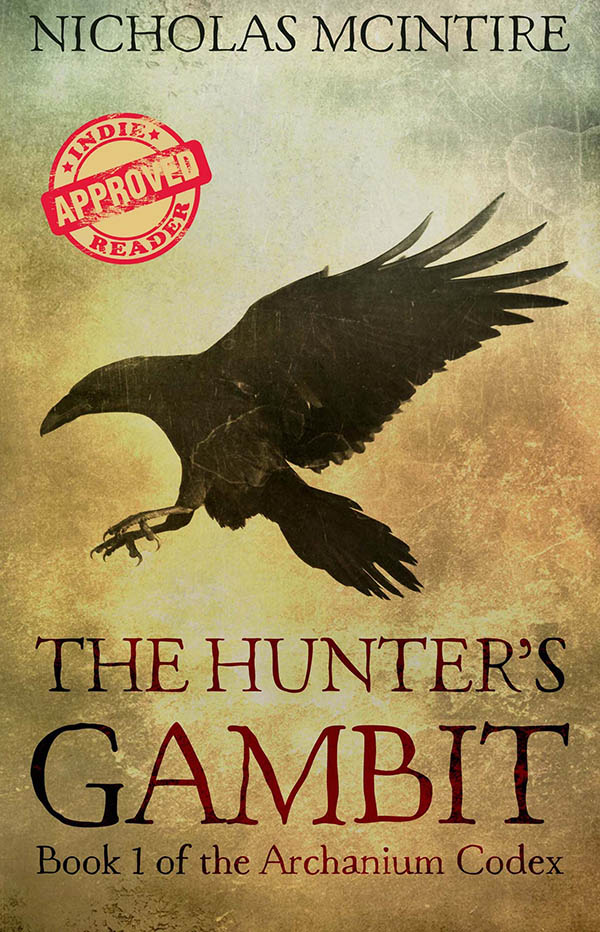
Nicholas McIntire has a new queer fantasy book out, The Archanium Codex book 1: “The Hunter’s Gambit.”
Aleksei Drago never expected an easy life, but he never expected what he got. Growing up amongst the Ri-Vhan of Seil Wood, losing his mother and just as suddenly being torn from the forest folk, Aleksei had no choice but to make the best of the unpredictable path in life.
But what happens when the monsters and figures of fiction become horrifyingly real? Can Aleksei find the right path? When his life and the lives of his family and friends are at stake will he fight, reforging himself into the man Prophecy demands he become? In a world of magic and Magi, of Angels and Demons alike, how will a simple farm boy survive his own contorted destiny?
This is the story of a seemingly-simple world gone mad, and the reality that every action, no matter how apparently benign, can serve to unravel terrifying truths. This is the story of Aleksei Drago, farmer, Hunter, and so much more.
Henry spent the rest of the day watching his son closely. Something was undeniably troubling him, but until Aleksei decided to open up to him there was nothing he could do.
“He’ll tell you in his own time, Henry.” he muttered under his breath.
So he waited. Every now and then he would engage his son in conversation, but every time he thought Aleksei might be on the brink of telling him something, the conversation fled to some superficial topic. Did he think it would rain by Market Day? Who did he think would bring the biggest pig to the Harvest Festival? Did he think Mother Margareta would come to bless their fields before the first frost?
Henry answered each question as though it was the direction he meant to steer the conversation, and refused to allow his frustration to surface. But by the end of the evening, he was no closer to understanding his son’s troubles than he’d been that morning.
Finally Aleksei rose from his seat before the fire, put his book away, and went to bed. Henry watched him go, more troubled than ever. The boy had never gone to bed without a word before. He always had some last comment to make, even if it was just to wonder at the next day’s activities.
Henry sat before the dying embers of the fire well into the night, thinking. He didn’t remember falling asleep, so when the voice woke him his eyes started open.
Hello, Henry.
He looked around, trying to get his bearings.
Gone was the heat of the hearth, the comfort of his chair. Instead he stood in an enveloping fog of shimmering gold.
He could see no one.
“Where am I?” Henry demanded.
A dream, Henry. This is merely an illusion. I apologize that I cannot offer you more comfortable surroundings at the moment.
“Who are you?” Henry called, feeling a touch foolish, shouting at phantoms.
His question went unanswered.
Henry, I’ve come to ask a favor.
“Who are you?” Henry repeated flatly.
There was a moment of hesitation before the voice responded. A man much like yourself, Henry Drago. One who only wants what’s best for your son.
“Speak then.”
When the favor was uttered, Henry blinked in confusion. A thousand questions bubbled to the surface, yet he found that he only possessed the strength to ask one.
“Why?” he choked, surprised by the weakness in his own voice.
The air before his face shimmered and distorted, as though he were looking through intense heat. Slowly, images formed. Images of Aleksei. An Aleksei he didn’t recognize.
“Why are you showing me this?” Henry managed.
Because I want you to see what your son could become. The man he could be, if you’d only let him. If you just do as I say.
“I don’t trust you.” Henry barked back. “I can’t even see your face.”
Another image shimmered into being. A man, though Henry saw nothing remarkable about him. The man leaned forward and whispered in his ear, and Henry heard the unmistakable ring of truth.
In that moment he thought he might have preferred a dagger to the heart. It would have been far less painful to simply die at the end of a highwayman’s blade than to agree to this. Either way, he would lose the most precious thing he had.
“Bargain struck.” Henry whispered bitterly, a tear winding its way down his cheek.
You’re doing your son a great service, Henry Drago.
The man even sounded earnest.
Henry started to say something, but even as he opened his mouth, darkness swirled around him. He slipped back into the empty chasms of sleep.
#
Morning greeted Aleksei gently, rousing him from a dreamless oblivion. It had taken him hours to finally find some rest, and his relief was immeasurable when he woke without encountering the specter of the green-eyed man. His wish had been granted. The man was gone.
He made his way down the narrow stairway and walked into the kitchen, frowning at what greeted him. Their rough wooden table was laid out with provisions for what Aleksei could only guess was a journey.
But a journey where? His father hadn’t said anything about travel. There was still wood to chop and hay to store. The first snow might be weeks away, but there was no telling when the winds would usher in the chill of Northern air. Working outside in the cold was not something he, nor any farmer, relished.
“I see you’re up.” Henry said from behind. Aleksei jumped.
He turned, “Da, where are we going? I thought we were going to finish the hay this morning.”
His father shook his head and smiled, though Aleksei caught the deep sadness in Henry’s eyes. “We aren’t going anywhere, Son. You are.”
Aleksei frowned, “Me? But I thought—”
His father tried to hold the smile, but it was forced, “You’re needed, Son. In the North.”
Aleksei thought his heart would stop. He forgot to breathe. He could hardly process what his father had just said.
You know the truth he speaks, Aleksei.
Aleksei fought back a sob of frustration. He thought he’d freed himself of the damned voice, but now he knew the truth. He would never be free from it. It would hound him until the end of his days, or until it drove him mad, whichever came first.
Or until you simply do as I ask.
“Why?” he finally managed.
His father looked out the kitchen window, and Aleksei followed his gaze. Dash waited patiently outside, a saddle fitted snugly about his muscular frame.
“Because you’re needed, Son. It’s the only answer I can give you.”
“I’m not needed here, Da? Don’t you need me?”
Henry bit back the pain in his voice, “You are more of a help than I can say, Aleksei, and I love you dearly. But no, I don’t need you. Not like this. If you stayed here, you’d be wasting something…extraordinary. And honestly, I think you’d know it too. They need you in the North, Son. And their need is much more important than mine.”
Aleksei stood there, stunned by what his father was saying to him. And then the questions came pouring forth. What did Henry mean by ‘extraordinary’? What had his father learned? What was still being kept from him?
“And I’m sorry I can’t give you the answers you want, Son. But I think you know who can. Find him.”
“But how can I….” Aleksei began, fighting back the tears springing into his eyes.
“You’re strong, Aleksei. You’ve always been strong. That won’t fail you now.”
Henry swallowed back his own tears and tried to smile again, “Now you’d better get on the road. The sooner you get beyond the Southern Plain, the better. You don’t want to be riding under the Harvest sun too long if you can help it.”
“But where am I going?” Aleksei cried, his voice breaking. It was happening too fast. His life was slipping through his fingers moment by moment and there was nothing he could do about it.
“North, Son. North. You’ll know where you’re headed as you get closer. That’s all I know to tell you.”
Aleksei looked into his father’s eyes and saw the sadness, the regret that burned within him. His father wanted to know just as badly as he, to know just what sort of place he was so blindly sending his son.
Finally, after a long silence, Aleksei nodded. “Alright, Da. If you want me to go, then I’ll go.”
“I’ll never want you to go, Son.” Henry whispered, his face contorting with pain. He had already lost his wife, and now he was losing his son, too. Aleksei would still be alive, but he would be so far away.
“But promise me something, Aleksei.”
Aleksei nodded, “Anything, Da.”
“If you find this place and if it’s not what you want, what you need, promise me you’ll come back. Even if this isn’t what you want either, at least we can figure that out together.”
Aleksei finally allowed a tear to wind its way down his cheek, “I promise, Da.”
Henry stepped forward and wrapped his arms tightly around his son, hugging him as close as he could, as though any moment Aleksei might turn to mist and vanish forever. Henry stepped back and managed a sardonic smile. Aleksei might remain solid as stone, but surely enough he was about to vanish.
#
Henry didn’t watch his son ride away. In truth, he couldn’t bear it. As long as he’d never seen Aleksei leave he could always pretend the boy was out in the barn, or by the pond he’d swum in as a child. It was a good hour before Henry allowed himself to sit down in his chair and sob.
Author Bio
Critically-acclaimed author Nicholas McIntire has been writing fantasy since he was 8 years old. The bones of the Archanium Codex were first created when he was 16, and in the past 20 years, he has taken that initially simple idea and crafted it into a fully realized world, finished the sequel, earned three degrees (one in Russian, Eastern European Studies, two in Nursing), and lived life to its fullest. Now writing full-time, Nicholas is ready for share is vision of the Archanium Codex, a 10 book series. The first book of the series being The Hunter’s Gambit.
Nicholas, lives in Fort Worth, Texas, but writes in both Fort Worth and Fort Davis, TX, where his family has a small place situated at 5200 feet in the Davis Mountains – and, yes, Texas does have mountains.
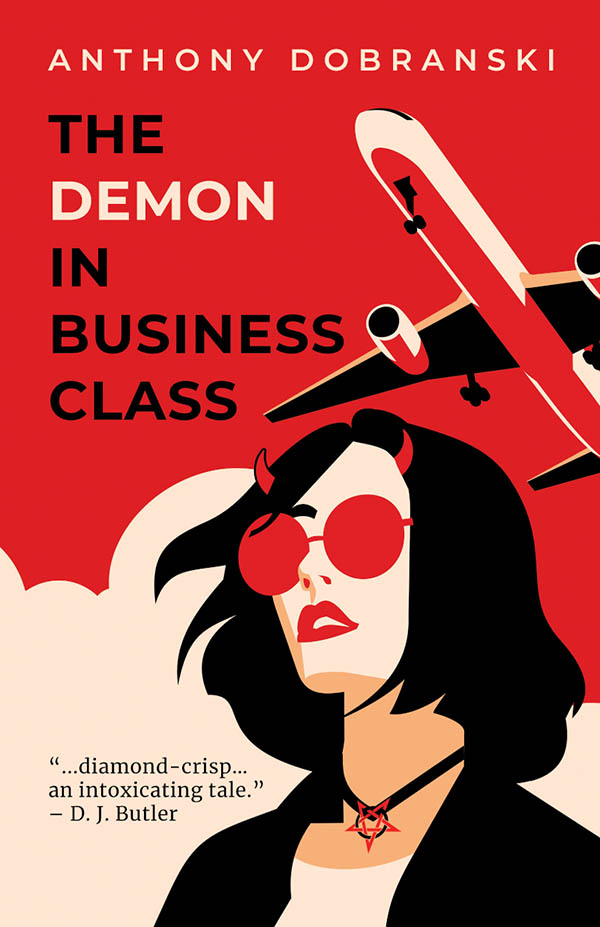
Anthony Dobransky stopped by the Land of Make Believe for a chat on writing craft and to celebrate his new release, The Demon in Business Class. Welcome, Anthony!
Interview
AQG: When did you know you wanted to write, and when did you discover that you were good at it?
AD: I first said it aloud to other people when I was 15, but I could already see my connection to it around age 11 or 12. Not that I was some literary event! I wrote dark, angsty stuff, of course, what you expect from a teen who reads a lot of dark fantasy. Just, I did it well enough to keep doing it, a good feedback loop. My friends, my teachers and my mother were very encouraging. I even wrote about being a writer in a college application essay. Since I got accepted into that college, I guess it worked!
AQG: Do you ever base your characters on real people? If so, what are the pitfalls you’ve run into doing so?
AD: I’ve used my friends in mental casting, in minor characters, more for their look or style — as if I was making an indie movie with them. One secondary character in The Demon in Business Class who is based on a real person is Walt, who is based on me! Or really, what I might have become in another life, if I never took writing as seriously as I did.
I don’t know about pitfalls, exactly, but I was conscious that Walt, however he began, had to grow his own way in the novel. He does things I would never do. If you’re going to base a character on a real person, be true to the character. Let them go their own way. Let them surprise you.
AQG: Have you ever taken a trip to research a story? Tell me about it.
AD: Three places I went specifically for The Demon in Business Class were Pittsburgh, Detroit, and Aberdeen, Scotland. Pittsburgh and Detroit were meant as research trips. I knocked around them for three days each, walking and riding buses in Pittsburgh, walking and driving Detroit. I visited city planning offices, talked with locals about how the cities had changed during what would have been my character’s time there. Mostly it was aimless, just to see and learn.
Once Scotch whisky became a thing for Gabriel, I wanted a locale in Scotland. As it happened, I had plans to go to Prague for a wedding, so I added a week in Scotland to the return trip. A woman I met in an Edinburgh pub told me about the hotel in Craigellachie, with its amazing bar of thousands of whiskies, so I rented a car and drove there. I stayed in Aberdeen, where, like my characters, I was disappointed with the hotel I picked. Together those created kind of an arc.
AQG: What is your writing Kryptonite?
AD: Brand names. Can’t stand them. If a writer tosses in brand names as a shorthand to convey wealth, glamour, expertise, anything really — in Ray-Ban glasses, looking at a gold Rolex watch, pushing Manolo Blahniks hard on the pedal of a Corvette Stingray — I just shut down. I’m like that character in William Gibson’s Pattern Recognition who has allergic reactions to the Michelin Man. I can forgive it if it’s done with a point, like the yuppie totems in American Psycho. Using brand names to say something the writer doesn’t actually say… it leaves a bad taste.
AQG: If you could tell your younger writing self anything, what would it be?
AD: People are not going to help you or take you seriously until you reach a certain level of success, or at least completion. You need to do it for yourself and for your vision. Expect indifference or contempt, even from those closest to you. Sorry! I’d like to believe they mean well, all those people who are negative about your dreams, and maybe they think they do mean well. But, to hell with them, expect nothing from them, they are messing with you, they are psychic farts in your elevator.
Seek out other writers, seek out readers of what you want to write, even if it’s not an exact match, even if it seems a huge effort. They are your only colleagues. Everyone else will class you as a wannabe until you actually are what you want to be. Now, get back to work.
AQG: What are you working on now, and when can we expect it?
I’m finishing up my new novel, The White Lake. It’s an Earth-based science-fiction, set in a future Budapest destroyed in a war, where the toxic waste has become its own very valuable industry. As I mentioned, it came in a dream, and it’s become a wild tale of Old World decadence, artificial intelligence, and sports media — like a cross between The Grand Budapest Hotel and Rollerball. Look for it next year!
She can speak all languages. He can smell evil intent.
They’re enemies. They crave each other.
With secret magic, international settings, a conspiracy plot, and star-crossed lovers, The Demon in Business Class is a stylish modern fantasy spanning continents and genres.
A shady executive hires Zarabeth Battrie to help start the next global war, giving her a demon that speaks all languages. But other people know more about her job than she does…
A resolute investigator recruits Gabriel Archer to use his emerging psychic powers, for a visionary leader who turns others from evil. As his senses develop, his doubts grow…
When the two meet by chance in Scotland, passion becomes fragile love, until the demon’s betrayal drives Gabriel away. Before Zarabeth’s revenge destroys the visionary’s plan, Gabriel must stop her — for both to survive, neither can win.
Fans of Jeff VanderMeer, David Mitchell and Michel Faber will love this cross-genre novel with crisp literary style. The Demon in Business Class is an international story of fantasy, intrigue, and love, on the uneasy ground where the human meets the divine.
YOUR NEXT READ IS NOW BOARDING
“If William Gibson wrote paranormal …. weaves the dark worlds of the occult and big business into an intoxicating tale.” – D. J. Butler, author of Witchy Eye
“Creative spark? Anthony Dobranski ignites a creative bonfire …A masterwork of invention.” – Mary Kay Zuravleff, author of Man Alive!
“A swank cocktail of international intrigue, steeped in the supernatural, mixed with literary flair …. so sleek it flies off the page.” – Zach Powers, author of First Cosmic Velocity
Warnings: FOR ADULTS! Drugs, fistfights, vigorous sex, murder, an orgy (witnessed), a cult, and a (told not shown) history of child sexual abuse.
In the fake-oak-paneled conference room, Zarabeth Battrie found a dozen others standing. All looked wilted and worn, with bunched shirts and bowing ankles. The plastic tables were gone, the plastic chairs stacked in the corner. More people arrived but no one unstacked the chairs. A herd instinct, Zarabeth decided, to keep a clear path for fleeing.
A natty beige man in a crisp blue plaid suit came in, pushing a low gray plastic cart with stacks of documents. If the standing people surprised him, he didn’t show it. With practiced ease he lowered the room’s screen, plugged in his powerstrip. Someone passed the documents around but no one spoke. In the silence, Zarabeth felt anxieties around her, about money, status, children, groping her like fevered predictable hands. Too intimate, these people’s worries in her skin when she didn’t know their names, or want to. She shook them off, pushed through to the front so as not to stare at men’s backs all meeting.
Projector light bleached the natty man while he talked through slides of sunsets and bullet points, with the real news a seeming afterthought. Her office and two others were merging with Optimized Deployments, in Boston. A great move. Efficiency for all. The animated org-chart realigned over and over, three squares gone and Optimized’s no bigger. Reorganized like a stomach does food.
People asked tired questions, their hot worry now clammy hope. The natty man smiled no matter what he said. Yes, redundancies. Jobs would move, details to work out. All would be well and better.
He left to spread his joy. The room lights rose.
Zarabeth’s boss, Aleksei Medev, slouched in the corner like someone had whacked his head with lumber. His unshaven olive skin hung gray and limp. With all eyes on him, he straightened.
“A very challenging time,” he said. “We’re sending reports to justify — to guide the transition. Client work is secondary.”
Zarabeth was in no hurry to fill out Aleksei’s useless reports. Nothing she had done in the last two months justified keeping her employed, she knew that. She went out the broken fire exit to a stand of pine trees behind the parking lot. She lit a cigarette, paced in the shade.
Once, Zarabeth Battrie had traveled the country as an Inspiration Manager, connecting the best people at Straightforward Consulting to an in-house knowledge network. She had good instincts which managers to flatter, which to cow, which to sneak past. It surprised her how much she understood when she finally got her quarry to talk their special arcana, over morning jogs, lobster lunches, steak dinners, midnight hookahs with shots of tequila. Later, on airplanes, she’d think of those and other conversations, watching the pieces fit together in this strange unity and balloon, her world growing with a drug-like jolt. To let her do that, week in week out — taking off, landing, on the move, on her feet — had been the greatest praise.
On Valentine’s Day, it had evaporated without explanation. Zarabeth had been reassigned to Reston, in the Virginia suburbs, to do public-relations grunt-work for industry trade groups. Aleksei Medev, still shiny then, had put his feet on her new desk and spun a great tale, core knowledge toward a turnkey marketing solution, select team deep study. At least she got an office with a door.
Zarabeth had visited Boston twice in her old job. Optimized had smart people and kept them by being greedy. They would suck the money from her division like marrow from bone. Everyone fired, no matter how they danced.
Doubt ate through her like some parasite come to lay its eggs. She pinched the cigarette’s cherry to burn it off with pain. Six years at this firm would not end this week.
#
Zarabeth sublet a furnished apartment in Foggy Bottom, facing west and the Potomac River. She had chosen it for the balcony view and the location near the highway, but she didn’t like the place much. The heavy dark furniture and metallic abstract art looked good at night, but menacing in morning shadow and grim in afternoon sun. Some days Zarabeth fantasized trashing it, taking a sledgehammer to the whole gloomy aquarium. This was a good day for that.
But Missy Devereaux was there, watching TV, in new red hair, her dirty bare feet on the coffee table.
“Hey, sugar,” Missy said, in her perky Kentucky accent. “Want some wine?”
“Get your bow legs off my table,” Zarabeth said. “When did you go ginger?”
“Do you love it?” Missy muted the sound. “I love it. Gramma hates it. Do you love it?”
A year ago, Missy Devereaux had been a Straightforward legislative liaison, frost-blonde hair and pricey suits, working her congressman daddy’s contact list. Now on the ground floor of Missy’s Georgetown mansion, her grandmother died slowly of bone cancer. Missy came to Zarabeth’s place as a retreat, a chance to smoke without blowing up the oxygen tanks. In return Missy watered the plants and filled the wine rack. It was a good arrangement, most days.
“It’s great.” Zarabeth went to her bedroom. She wiped off her makeup, washed her face with cold water. Her copper skin looked flushed. Small zits on her forehead. Twenty-seven, and she still broke out. She turned from the mirror so as not to smash it.
Missy came with a glass of white. “Three hours ’til the nurse leaves. You want dinner?”
Zarabeth shook with fury. “I so don’t deserve this.”
“I know, sugar-pea. I know.”
“The fuck you know, witch?”
Missy’s eyes flashed, from blue to bright green. Like the unlocking of a cage.
Zarabeth backed down. She checked herself by punching her palm repeatedly. “Fuck me! Fucking fuck.”
“You just relax,” Missy said. Maybe to herself too. Her eyes blue again, at least. She pulled a joint from behind her ear. “Drink and smoke. I’m ordering food. Lamb kebab with fries, right?” She closed the door.
Author Bio
Anthony Dobranski is a native of Washington DC. He studied English Literature at Yale and made his first career working internationally for AOL. His first novel is the cross-genre modern fantasy The Demon in Business Class. He also created Business Class Tarot, a modern Tarot deck inspired by his novel. He is a member of SFWA, and serves on the board of The Inner Loop, a Washington DC live-reading series. He lives in Washington now with his family. He loves to ski.
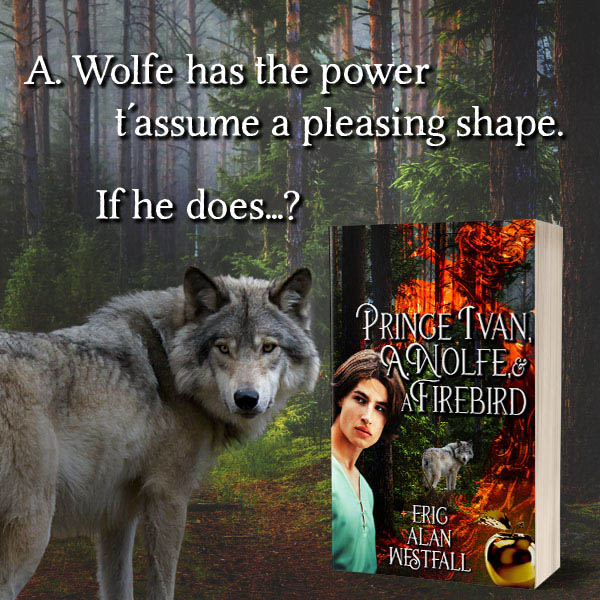
Eric Alan Westfall has a new queer fairy tale out: Prince Ivan, “A. Wolfe & A Firebird.” And there’s a giveaway!
Dear Reader,
What do you get when you combine a greedy Great Tsar, his two cheating, bullying older sons, his youngest esser (shh! no saying that aloud) son, stolen gold apples, a Firebird quest, A. Wolfe who has the power t’assume a pleasing shape, a magickal sandstorm, as well as two bands and a full Symphony of Gipsumies?
A rollicking, roisterous Russian Fairy Tale, with vigorous esser activities in tents, halls, bedrooms and alcoves, with and without the assistance of PSTs. Plus princely parades, a duel over Gus, new lyrics to an old drinking song, and the possibility of bits of blood, gobs of gore or moments of mayhem. As required by CORA (the Code of RFT Authors), should these occur, your author will give you timely warning.
Ah. Still not ready to part with your kopek-equivalent? Consider the fun you’ll have reading chapters like:
“To Kvetch, Or Not To Kvetch? A Reader’s Choice”
“Ivan Has A Close Encounter Of The F-Word Kind”
“Second Direction Questers vs. The Caliph’s Sayer Of Sooths”
“Will Sasha Succeed In Seducing Prince Ivan?”
“Bad Prince Ivan! No Touch Cage!”
“A Travel Pause For Gratuitous Sex In The Tent—Which Does Not Advance The Plot—At The Insistence Of The Characters”
“A Necessary Interlude To Consider The Age-Old Questing Question: What The [Expletive Of Your Choice, Dear Reader] Do We Do Next?”
If you buy it and try it, you’ll like it, or so says your most talen…er…humble author.
p.s. If Karrie Jax and I have covered you and blurbed you to buy, look for “Dear Reader, Along The Way, Did You Happen To See The Allusion To Olivier?” in the TOC. It’s a spot-the-allusions chance at gift cards of $25, $15, or $10.
166,000 words of story fun and frolic, plus a 2160-word teaser from another MM fairytale: The Tinderbox.
Anatol had no plan for preventing more apple-depredations, though he had the morning to think of one, and the afternoon to pull the pieces together, before implementing it at nightfall.
He made an Imperial choice. Stealing an idea was far easier than creating one. He would do Vlad’s plan, only right. Without flasks. Even if Father hadn’t noticed the faint flask clink-clank, Anatol had. And the Vlad-servant on Anatol’s payroll later confirmed both four and Moskvaboya.
By late afternoon, Anatol had supervised the servants in setting out a triple row of lanterns, with all the supplies necessary for three re-lightings. Which is to say, he watched them figure out how many were needed for the three around-the-tree circles, far enough out there was no risk of the tree catching fire. Plus figuring the right distance between the circles, so when one was bending, lifting, lighting, and setting down again for the middle circle, one didn’t get one’s bottom burned by the next circle out or in.
It never occurred to the servants—perhaps it never occurred to them—to base their distances on the amount of space taken up by a big-boned middle prince, as opposed to basing distances on underfed, overworked, short, skinny servants like themselves.
Ha! So there, Vlad! was a thought which might have galloped across Anatol’s mind, as he examined the lay-out immediately after all the lanterns in each of the tree-centered circles were lit. Despite having watched all those servants, doing all the work, Anatol was confident he could repeat their efforts one or two times, depending on how long the lanterns lasted, by himself. The work would keep him awake, aware, and apple-alert.
No apples would be taken while he was watching!
When Anatol woke the next morning, slumped against the trunk, he realized an apple-watching truth. A body more used to acceptable aristocratic and/or Imperial activities—including, but not limited to, wining, dining, whoring, wagering, dancing, fencing, fisticuffs, riding, racing, et cetera, plus the occasional brawl with his older brother—wasn’t up to the strain of doing all the work required for lighting and re-lighting, so many, many, many lanterns, all on its own.
Like his brother before him, four apples were missing. Like his brother, he was asleep during the red-gold-white flashes, the fluttering and the flapping. Like his brother, he was upright and fake-alert when the Great Tsar, Vlad and Ivan arrived. Anatol followed in his brother’s mouth-steps, lying with exquisite believability, and head-down humility, about having stayed awake all night.
The Great Tsar did not take it well, but not having made a spectacle of Vlad, he couldn’t very well do it to Anatol.
“Your turn, Ivan,” the Great Tsar said. His face and tone said he had no expectation of a different result from an Ivan-watch, not when the boy’s bigger, better, brighter, stronger, older brothers, had done their duty by staying awake all night and still failed. In fact, he suspected his youngest would soon fall asleep, and since he was as honest and truthful as Vlad and Anatol, Ivan would admit his fault.
And perhaps give the Great Tsar a reason to vent some of the rage over lost apples.
“Sire,” Ivan said with a deep and respectful bow, before walking away.
An authorial note of some pertinence for thaose impertinent enough to whine, whinge, or under-breath mutter or murmur about the shortness of certain things.
No, not those things. Those things, and the shortness or longness thereof, have not yet been fully, as it were, introduced in our tale, aside from the brief references above.
Thus: yes, this is a short chapter, but if you’re really interested in a lengthy description of Anatol doing his own walking, bending, et cetera, and other tree-watching activities, the author respectfully suggests the following:
1. Find a Song Mage despite being on a World Beside with no magick.
2. Mortgage all you own, or sell your soul to whatever demon desires it, to meet the Mage’s price.
3. Turn all your money and/or cash equivalents over to the Song Mage and have him Sing the Door to Prince Ivan’s World Beside all the way open.
4. Step through quickly.
5. Find me, somewhere in a strange, strange, really strange land with no one to help you grok anything.
6. Ask me politely to provide you with the longer version of this chapter.
7. Accept what happens thereafter.
Just sayin’, as someone sometimes says in your World Beside.
Author Bio
Eric is an American Midwesterner, and as Lady Glenhaven might say, “He’s old enough to have sailed with Noah.” In the real world he writes for a living, with those who would claim what he writes is fiction. His partner of thirty years—who died unexpectedly in 1995—enthusiastically encouraged him to try to get his writing published (mostly poetry back then, plus some short stories), but he didn’t have the guts to do so until 2013. At this point he’s not sure which was officially first, The Song, or Like a Mountain, Waiting.
Starting then, he’s published 13 novels and novellas, 1 poetry collection, 2 short story collections, and 3 short stories. God willin’ and the crick don’t rise, 2020 will also see The Tinderbox out and about. But since real life is, as we all know, a pain in the (anatomical site of your choice)…no guarantees.
Please welcome Wayne Goodman to the Land of Make Believe. Wayne is here today to share his new collection of speculative fiction, romance, and historical fiction short stories.
All The Right Places:
I live in the San Francisco Bay Area with my partner Rick May (and too many cats). My writing has tended to be historical fiction with a focus on LGBTQ+ characters. When not writing, I like to play piano music from the Gilded Age with an emphasis on Women, Black, and Gay composers.
Since October 2018, I have hosted Queer Words Podcast, conversations with queer-identified authors about their works and lives (www.queerwords.org). Each week I release at least one 20-30 minute episode featuring writers from the barely-known to the well-known. We talk about their queer experiences as well as their literary works. If you are a published, queer-identified author and would like to be featured in a future episode, you can write to: [email protected].
From time-to-time I submitted short stories to anthologies or collections. Some got accepted and printed, many received polite rejections. After a few years my compilation of shorter works grew to a point where I wanted to publish them together. “All the Right Places” contains eleven pieces that take place starting in the near future and chronologically progressing to the near past.
One piece of public art that has fascinated me sits at London’s Piccadilly Circus. Atop a circular pedestal, the statue of Anteros (usually mislabeled Eros) has acquired a mystique for bringing potential lovers together. I find it so compelling that two of the stories begin and end there (the title story and “Nice Day for a Picnic”).
Here is an excerpt from “Nice Day for a Picnic,” which takes place in 1895 London. The narrator sought employment based on a school friend’s recommendation.
A large brass knocker in the shape of a bull’s head dominated the otherwise ordinary slab of wood. I lifted the thing’s head expecting it to moo or snort, but it merely created a loud “thud” when I let it free.
A moment later, the door opened a hand’s-width, and a rather tall woman in a conservative, high-collar frock addressed me through the narrow gap. “May I be of assistance?” Her voice sounded somewhat deep for a woman.
“Oh, yes, please,” I stammered. “I’m looking for a friend of mine who gave me this calling card.” I retrieved it from my pocket and slipped the card through the opening. She snatched it from my fingers, examined it quickly and handed it back. Her expression remained placid, neither acknowledging nor denying that I was at the correct place. “His name, ma’am, is Algernon. Algernon Fitzhugh.”
Her already arched eyebrows raised even higher. “I see. Well. You had better come in then, Dear Heart.” She opened the door fully and walked away along a narrow entrance hall. I have been referred to as “Love,” “Sir,” “Master,” “Mister,” and “Sweetie,” but never “Dear Heart.”
Once inside, I could see that her manner of dress appeared quite odd. She wore neither corset nor bustle, and the puce-coloured dress seemed nearly vertical in its lines. Her chestnut hair appeared to have been plopped atop her head and knotted with a grey bow, yet it still managed to cover her ears.
She led me to a cosy sitting room with a few plush high-back chairs and a low table. Pointing her rather large hand, she indicated one of the chairs, and I sat down nervously. As I looked about the dark-panelled room, I could see stacks of ornamented china plates and cups, all in a creamy shade of light blue.
“It’s Wedgwood, Dear Heart,” the woman explained, “Old Josiah himself once lived here and left some of his handiwork behind. Would you care for some tea?”
When I looked into her eyes for the first time, I realised they matched the colour of the china almost exactly. “Yes, ma’am. If you please, ma’am.”
She elevated her chin as if looking for stray dust on the ceiling. “Please do not call me ‘ma’am.’ It makes me feel rather like an old lady. Mrs. Borden is the name, if you please.”
“Oh, as in Mrs. Borden’s?”
“Yes, Dear Heart, the very one.” She disappeared through a swinging door.
What had Algie gotten himself into? This mysterious woman, this mysterious home, this mysterious life. I just hoped he had not fallen victim to the undertow of immorality.
“Here you go, Dear Heart.” Mrs. Borden returned carrying a silver-plate tea tray with two Wedgwood cups. She set it on the low table. “I’ve already taken the liberty of putting milk and sugar in the cup. I know how you Oxford boys like yours sweet.” A hint of a smile wrinkled her face.
“How did you know I attend Oxford?”
The smile broadened. “Because of your acquaintance with young Algernon, of course.” She poured from the teapot a cupful each. “I’m afraid your friend is out on business at the moment, but you’re welcome to keep me company until he returns.”
“Thank you. Thank you very much indeed, Mrs. Borden.” I looked about the room. “Will Mr. Borden be joining us? I don’t want to seem improper.”
The woman’s smile turned into pursed lips, “There is no Mr. Borden.” She stirred using a small silver-plate spoon, which called attention to the size of her hand, especially with the pinkie extended. Two taps on the rim and she set the spoon back on the tray.
“Oh, I am truly sorry to hear that.”
“No, Dear Heart,” she placed the same rough, warm hand with slightly hairy knuckles upon mine. “There never was a Mr. Borden,” and she winked at me. I wanted to pull my hand back but did not wish to seem rude to my hostess, and it remained under her cover until she finally decided to take her tea.
“All the Right Places” is a collection of short stories, most written for submission to anthologies or collections. Starting in the near future and proceeding to the near past, men interact with other men in the pursuit of love and companionship.
Gary had never seen the likes of the boy who just walked into Mixer, one of the more recent bars to open in Chelsea. He had a farm-hewn look, like he just stepped down from a tractor clenching a dried stalk of wheat grass between his teeth.
Something about this stranger seemed intriguing, inviting, alluring. So out-of-place in this ultra-modern wash of dark walls, neon strip lights and fake smoke. The designer had set up the entrance so that each person walking in would emerge into the main room from a cloud of fog, like walking out of a dream.
And this seemed much like a dream to Gary. A hayseed hick in a flashy lower Manhattan gay bar. The kind of thing he used to watch at home on video late at night when he couldn’t make a good connection at the bar. Just like in the dream, or video, the bucolic lad walked up to him.
“Hello, I’m Elmo,” the farm boy thrust out his rough-looking right hand, presumably to shake with Gary. Unfortunately, the surprisingly-different name sent him into a giggle fit. “Did I say something wrong? I’m awfully sorry if I did. Perhaps I should just leave now.” Elmo turned to go.
“No, wait, Elmo,” Gary managed to blurt out before he started laughing again, almost spilling the pricey drink he had fought the jaded crowd to purchase. The liquid in the glass glowed blue in the light of the plexiglass bartop. “Can I buy you a drink? Are you even old enough to be in here?”
The farm boy had a very fresh and youthful appearance, except for the roughness of his palms. Elmo gazed down into those work-worn hands before responding, “I am not in the habit of accepting charity from strangers, but,” and he glanced up at Gary’s shirt and then his face, “I believe I am prepared to try something new tonight. Oh, and yes, I just turned 21 last week. What are you drinking, sir?”
“A Blue Moon,” Gary responded as he pointed his free hand at the glass. “Two things”–he held up two fingers–“First off, this is not a drink for rank beginners, and two, if you call me ‘sir’ again, the deal’s off.” Elmo looked down. “Hey, up here, man. My name is Gary.”
Elmo looked up and smiled. “Thank you… Gary.”
And Gary returned the smile. Possible fantasy scenarios began to form in his overcharged imagination. “Do you like beer?”
“Of course!” Elmo’s smile widened. “We have all kinds of beer at home: Apple Beer, Ginger Beer, Root Beer –”
“Do any of them have alcohol?” Gary interrupted.
“Oh, no,” his moppy head shook side to side, “we’re not supposed to drink alcohol.”
“But you do, Elmo, don’t you?”
A wicked smile spread across his face, “Oh, yeah, sure, but please don’t tell my pa.”
Gary gently grasped Elmo’s arm. “Don’t you worry yourself none, Elmo, your secret is safe with me.” He then turned to the bartender and ordered a lite beer. Once he had finished settling, he took the bottle in his free hand and turned back to Elmo. “I wish we could find a place to sit and chat, but this bar is so crowded.”
“What about there?” Elmo pointed to a café table where two nattily-dressed men had just stood up.
“Well, aren’t you my little lucky charm, Elmo.” He guided them to the recently-abandoned seats. “So… what brings a nice young boy like you into a filthy old place like this?” Once he had set the two drinks on the table, he waved his arms around to indicate the space.
“Oh, no. This is far from filthy. If you want filthy, I can show you the cow stalls.” Elmo’s head rotated around as he took in the new surroundings. “And why did you start laughing when I told you my name?” He confronted Gary directly.
“Oh”–he smiled–“it’s not a name you hear very often. The only Elmo I ever knew was the one on Sesame Street.”
“Is that far from here? Is it in Manhattan?”
Gary burst out laughing. “Are you for reals? Or are you just pranking me?”
“I’m not sure I understand what you are asking me, sir–Gary.” His wide eyes suggested his innocence to be sincere. “Where I live, there are quite a few of us–Elmos, that is. In fact, folks usually call me Elmo Number 2, or just Number 2 for short.”
“You are just full of surprises, Elmo Number 2.” Gary grinned. “At first I had to suppress the urge to tickle you all over.” He wiggled his fingers and moved his hands up and down.
“Why would you want to do that?” Elmo sipped at the beer.
“Well, a few years back there was this toy that… oh, never mind.” Elmo seemed focused on Gary’s shirt. “Is there something wrong with my shirt? You keep looking at it.”
“Oh, no.” He blushed. “It’s the color. It’s what drew me to you.”
“Blue. Blue is what made you bee line from the door up to me and tell me your name?” Elmo nodded his head. “Think you could you help me out with a bit of an explanation?”
“Oh, sure,” he took another sip of the beer, “And thank you for this. It’s not bad. You see, at home, that shade of blue has a special significance for us.”
“Home?” Gary gave him the once over once again. “And where might that be, Elmo?”
“Lancaster, of course!”
“Of course. I should have known. And you pronounce it way different from what I am used to. We say Lan-caster, but you call it ‘Lank-a-ster.’”
“Really? I’ve never heard it pronounced any other way.”
“Uhn huhn,” Gary started searching out other faces, just in case this cute little fantasy disappeared into a dust cloud. “So… what brings you to New York, Elmo Number 2?”
The farm boy giggled, “Number 2. It sounds so different when you say it.” He giggled again. Perhaps it was the beer kicking in. “I’m on Rumspringa. Are you familiar with that?”
“Is it some new drug?” Gary stared down into his drink.
“Oh, no, silly. It’s my time to discover what the outside world has to offer before I commit to my adult life.”
“I think I saw a movie about that. Are you Amish or something?”
“Sort of. We like to call ourselves Pennsylvania Dutch, but it’s very similar. My folks are more modern than some of the other groups.”
“Obviously.”
“Obviously?”
“Don’t you people ride around in horse buggies? No electricity, no cell phones.”
“Oh, that’s the older ones. We’re not so strict like that anymore.”
“I see,” Gary’s eyes wandered over Elmo’s body anew as fantasies began to redevelop. “So… you’re in New York to see the sights?”
Author Bio
Wayne Goodman has lived in the San Francisco Bay Area most of his life (with too many cats). He hosts Queer Words Podcast, conversations with queer-identified authors about their works and lives. When not writing, Goodman enjoys playing Gilded Age parlor music on the piano, with an emphasis on women, gay, and Black composers.
Today we welcome M.D Grimm to the Land of Make Believe to share a little bit about Lance, in her new release, Healing Lance!
Good day lovely readers! Thank you for joining me. I am M.D. Grimm and I am here to promote my newest release, “Healing Lance.” This is the first book in the “A Warrior’s Redemption” trilogy. This is a bit of a “pet project” that I am overjoyed to finally reveal to the world. The next two books, “Forgiving Lance” and “Avenging Lance” will be released in August and September, respectively.
So… what can I say about Lance? He’s complicated for sure. He’s probably one of the most complicated characters I’ve written so far. He wasn’t always that way.
In my first outline for the story, he was very different. He was more like a jaded, war weary soldier that had done many brutal things and decided to change his ways and seek redemption. While elements of that remained, his personality and his backstory changed drastically. Now, it was more like he was a child awakening from a nightmare. And yet the nightmare was real and all the crimes he’d committed needed to be recognized and he needed to atone. This change allowed me to play with his personality and his perspective a lot more than in the original. He’s simplistic in his thinking and yet also perceptive and interested in the world around him. He was basically numb for the majority of his formative years and only really started to live when he finally rebelled against the warlord that “formed” him.
I have always been interested with the dichotomy between villain and hero. Sometimes the difference is minute and the separating line is thin. Lance is equal parts victim and victimizer. He’s villain and hero. Throughout the trilogy, I explore the two sides as Lance himself tries to understand who he is and who he wants to be. It’s a question, I’m sure, we all ask ourselves at least once in our lives. Who am I? What is my purpose?
Other questions might be: Am I who I make myself? Am I what other people say I am? If others consider you a monster, are you? Do you become what others say you are or are you only what you think you are? I also question the ideas of redemption and forgiveness. I find that the best fantasies are those that revolve around human follies.
I don’t think such questions have any definite answers. It’s all nuanced and complicated, and it was interesting to explore these aspects and themes within the story.
Lance certainly has monstrous qualities. And yet he can be kind and gentle and compassionate. He’s a beast in battle and yet finds childlike joy in cuddling a puppy. He’s a boy that was molded into a weapon that became a man with a lifetime of guilt and the need to redeem himself.
Can we truly redeem ourselves? Can we seek and receive forgiveness if we truly regret our past actions? Are there crimes that can never be forgiven?
I think the answers to such questions are individualized. It would be too easy to say that there were “right” or “wrong” answers. Everyone has their own criteria.
Lance might have started as a rather generic war-weary soldier but he became something more. Writing his story took me on a fascinating journey, and I fell a bit more in love with him with each book. I hope you will to!
The next two books in the trilogy, “Forgiving Lance” and “Avenging Lance” are available for preorder at Amazon and Smashwords. I also have a newsletter that I try to send out monthly with all the goodies you can expect in the future. If you’re a fan of my book “Leopold” (Saga of the Bold People 1) then you might be excited to learn that the sequel, “Legacy” will be out in October 2020. More information can be found at my website.
I also plan on republishing my entire Shifter Chronicles, On Wings Saga, and Eye of the Beholder in 2021, with updated and expanded text for most of them. Keep your eyes peeled for those!
I hope you stay safe and healthy, and may dragons guard your dreams,
M.D. Grimm
Healing Lance
A baby’s laughter.
A mind uncaged.
Lance is known as Scourge, the warrior in the black armor, the dog of the warlord Ulfr Blackwolf. He was just a boy when Ulfr found him and molded him into the perfect weapon. He slaughters and pillages on command, merciless and numb, devoid of emotions. Then a baby girl laughs at him during a raid.
And everything changes.
When Gust, a talented healer, is out deer hunting and stumbles across a magnificent horse bearing a mortally wounded rider, he has no idea that his life is about to change forever. Gust applies all his skills to his patient, determined to save the rider’s life, and is rewarded when the man opens his eyes.
As friendship, and more, bloom between warrior and healer, so does the danger over the horizon. Ulfr has not forgotten, and Lance must take his first steps on the long road to redemption.
Direct Link: http://www.rafflecopter.com/rafl/display/b60e8d47137/?
Excerpt
Chapter One
The baby shouldn’t matter. But she did.
He easily held her small body in his broad hands. He knew the baby was a girl because she was naked. She kicked her legs as if she wanted to dance, and her wide amber eyes gazed at him in seeming fascination. He stared down at her, wondering why she didn’t scream. Didn’t babies scream? Adults certainly did when they saw him. He didn’t like the sound. All he wanted to do was silence the noise.
The baby stared at him a moment before her mouth curled up at the corners, and she laughed. He froze at the unusual sound. With eyes alight, she grabbed her feet and continued to laugh. It was… all the things foreign to him. It wasn’t cruel or dark but careless, showing a freedom he’d never known. She wiggled in his hands, her pale, pink body flush with life and potential.
Battle roars and the cries of the dying met his ears again, in stark contrast to the little life he held. He wrenched his gaze away from her and looked around the charred hut and over the collapsed roof. The light from the fires consuming the village illuminated the destruction and the blood splattered on the walls and floor. It was a view he was accustomed to, one he understood. The weight of his sword was one he only noticed when it wasn’t there. He returned his gaze to the baby. This was something he didn’t understand. She was confusing.
She laughed again as goosebumps broke out over her body. She was cold. He scanned the area and spotted a blanket that only had blood on one corner. He wrapped her as best he could, another thing unfamiliar to him, and his black armored gloves made the action awkward. Then he pressed her against his steel chest. He wanted her to survive. He didn’t know why—he just knew he didn’t want her to die.
“Please….”
A young woman lay on the floor at his feet, one he thought was dead. It appeared she had only been knocked out. She lay on her side, one arm stretched out to him, her normally golden skin sickly pale. Her dark brown hair was short, barely reaching past her ears, and one side of her head was caked with blood. The southern part of the kingdom of Grekenus didn’t seem too fond of hair as most of the men in the village were bald and beardless while the women grew hair no longer than their chins.
“Please don’t kill her,” she said, dark eyes wide and dazed. “Don’t kill my daughter. Please, I beg you.”
She spoke in Spart, the native language of the kingdom. He knew it well enough to communicate effectively.
He looked at the baby and then back at the woman. If he wanted the baby to survive, she needed a caretaker. Since the woman was her mother, who better? He strode over to the woman where she struggled to rise and grabbed her arm. She winced at his grip as he tugged her to her feet. He shoved the baby into her arms before dragging her outside.
“What are you—?”
“Silence,” he said curtly. He observed the chaos through the smoke and beyond the fires. The broken dead littered the ground and fire ate everything it touched. A horse galloped toward them, one that belonged to the village since there was neither a saddle nor bridle on the beast. He let go of the woman and pointed to the ground.
“Stay.” Then he strode in front of the horse and held up his hands. The beast reared on her hind legs, neighing in fright. Unlike with humans, he knew how to speak to horses. It wasn’t long before he’d calmed her and had her under control. He petted her neck and muzzle, whispering kind words. The frantic look in her eyes eased, and he led her over to the woman and the baby. She swayed on her feet and had stayed where he told her to, not that he’d doubted she would. The hope for escape let her trust him.
He quickly found a length of rope and looped it around the horse’s nose and neck.
“Get on.”
She didn’t question him this time. She struggled to follow his command, and he realized the horse was just too tall for her to mount without help. He shoved her up, and she sat unsteadily on the horse’s back, her daughter clutched to her chest. She stared at him, and he noted the blood from her head now stained the side of her face and dress. She would see nothing of his face since his black armor covered every piece of flesh, and his eyes were barely visible through the narrow visor slit of the helmet.
“Go.” He slapped the horse’s rear and the mare bolted. The woman leaned over the horse and let the mare lead them away from death.
Another warrior, part of the warband, nocked an arrow and leveled it at her. He strode over and kicked the warrior’s knee, sending the man crashing to the ground with a scream of pain. The arrow flew wide. Another warrior was about to give chase on horseback, and he dashed over to grab the sword from his hand before shoving the warrior off the saddle. A few other attempts were made to stop the fleeing woman, and he stopped them all, causing various injuries and not caring in the least. He had no affinity to any of the warriors in the warband. He had no affinity to anyone… except the tiny girl.
He still couldn’t figure out why. He wondered if he ever would.
He stood there, on the muddy ground soaked with blood, staring after the woman. The smoke burned his throat and stung his eyes. The scent, the noise, the mess of battle he knew like he knew his name. He’d never been curious about anything beyond his current life. Now he did.
He hoped she took good care of her daughter.
“Lance!”
He blinked and turned around. The warlord Ulfr, known throughout the Nifdem Empire as Mad Blackwolf, stalked over to him, expression like a thundercloud, his black, bushy beard and thick head of hair obscuring most of his ruddy face. He wasn’t as tall as Lance, although he was much broader, and there wasn’t a weak bone in his burly body. The quality of his black long-sleeved tunic, trousers, and boots showed a hard but fruitful life, and a few glistening red splatters indicated he didn’t leave all the fun to his warriors.
A few of the warriors that Lance had attacked hobbled after their commander, scowling and muttering curses. All the men sported beards of one length or another. Lance remained clean shaven since the helmet made having a beard quite painful as it tugged on the strands and chafed his skin.
“You will explain to me why you disobeyed a direct order!” Ulfr said when he reached Lance. He spoke in Taris, the official language of the empire. His clenched fists and tight jaw indicated his fury, and the rest of the men and women in their warband cowered at such a sight.
Not Lance. He didn’t feel fear.
Lance took off his helmet, long honey blond hair sticking to his face, pressed there by the constriction of the helmet and sweat glistening on his pale skin. Frosty blue eyes stared at Ulfr, eyes hollow from years of war and brutality. Yet, if Ulfr had looked closer, he would have seen a spark of life newly lit in the void.
Lance tucked the helmet in the crook of his arm and smoothed back his hair, the armor grinding and clanking.
“I didn’t want the baby to die.”
Ulfr blinked. “What?”
Lance frowned. He knew Ulfr had heard him clearly enough. “I did not want the baby to die,” he said, slower this time. “She couldn’t survive on her own, so she had to have her mother with her.”
Men and women gathered around them, filthy warriors stained with the evidence of their raid and slaughter. Everyone wore trousers and tunics, though some of the women chose more form-fitting clothing that extenuated their feminine attributes. The ethnicities in Ulfr’s band were as varied as the colors of their wardrobes. Though none dared wear purple or, worse, silver and purple combined. A person could be killed for being so presumptions. Only imperial royalty wore those colors.
Several men were retying their trousers, having violated their victims before killing them. Lance observed the crowd with a detached eye. He knew what would happen now. He’d known it the moment he made the decision to save the infant.
“You disobeyed me!” Ulfr gripped the collar of Lance’s breastplate and yanked him closer until their faces were inches apart. “You showed mercy when I told you all to slaughter those who don’t give us tribute. These people spat on us as if they were better, and so they deserved their punishment. You’ve followed my orders before, Lance. Why not now?”
“I told you.”
Ulfr shoved him away. Lance stumbled back two steps before standing still, like an oak tree against a high wind.
The complete slaughter of a village or town wasn’t what Ulfr usually did. He wouldn’t raid if they paid him. Normally, if they resisted, Lance would only kill one or two people to make a point, and then the villagers would hand over whatever Ulfr wanted to make him go away. This village had done that in the past, and yet they recently decided to fight back against Ulfr’s protection racket. They paid the ultimate price, an example to all who dared defy Mad Blackwolf.
The village was close to the border between the kingdoms of Grekenus and Cairon, and mostly safe from the ravages of the civil war, since it was deep into the protective territory of one of the kings. And yet sometimes, like that day, warlords got through. Ulfr’s band had had scuffles with army units now and then over the years that gave Lance more of a challenge, but none recently.
“You disobeyed me for a wench and her spawn?”
“I did not want the baby to die,” Lance repeated.
“You will go after her.” Ulfr pointed in the direction the woman had fled in. “You will redeem yourself and escape my wrath but only if you go now.”
“No.”
Every single man and woman there gaped, eyes wide.
Ulfr’s eyes bulged and his face grew red. “You ungrateful maggot! Who raised you? Trained you? Who saved you from becoming crow food or sold into slavery? You owe me your loyalty!”
Lance stared at Ulfr. Yes, all he said was true. But there was no way Lance could ever hold his sword over the neck of that baby and kill her. Her laugh echoed in his mind and seemed to unlock something. Something scarred shut.
No, she would live.
He dropped his helmet to the bloody mud, followed by his sword, which had taken countless lives without mercy or hesitation. He stood before the warriors, those he’d trained and slaughtered alongside. Despite living with them, killing with them, he didn’t know them at all. He never cared to.
“I am done,” he said.
Author Bio
M.D. Grimm has wanted to write stories since second grade (kind of young to make life decisions, but whatever) and nothing has changed since then (well, plenty of things actually, but not that!). Thankfully, she has indulgent parents who let her dream, but also made sure she understood she’d need a steady job to pay the bills (they never let her forget it!).
After graduating from the University of Oregon and majoring in English, (let’s be honest: useless degree, what else was she going to do with it?) she started on her writing career and couldn’t be happier.
Working by day and writing by night (or any spare time she can carve out), she enjoys embarking on romantic quests and daring adventures (living vicariously, you could say) and creating characters that always triumph against the villain, (or else what’s the point?) finding their soul mate in the process.